PSA: Maryland Jerseys On Sale Now

DSFkMCOUIAA_7ar.jpg

While this isn’t a paid product placement at all, I’ve got to let everyone know that the University of Maryland club hockey team is releasing their jerseys for sale for the month of January.

A link to their Google Form for the jersey is here and you should definitely look into getting one because they are slick as hell. At the price point of $120 plus $10 shipping, it’s a pretty decent deal to say the least.

More over, it’s to help the team out. Which they are trying to get the pride of Maryland out to the masses, it also is helping pay the teams bills. The club hockey team has to pay a lot of things out of pocket– especially for ice time and uniforms. The team set up a Go Fund Me earlier in the year to help with the costs of new white jerseys after the school ditch the script that the team had on the front of their whites. I’m assuming to stay in the good graces of the school and to get some kind of funding, the team had to change it. Rather than go out of pocket, the Go Fund Me got to about 75-80% of the goal when all was said and done, which help off-set a huge cost to the players.

At the semester break, the Terps are ranked #9 in the ACHA Southeast Division II standings with a 13-6-1 record. The team is currently on a three-game winning streak, while also winning nine of their last ten games heading into the break. In those nine wins, the Terps have outscored their opponents 53-19. The Terps will return to the ice January 19th at their home rink of the Laurel Ice Gardens to take on Rowan University.

So, get yourself a new jersey for your collection, support college club hockey, and show up to random pro games with an amazing jersey on your back. It’s a win-win-win in my book.

Olympic Hope Adds to Already Amazing Tournament at Spengler Cup

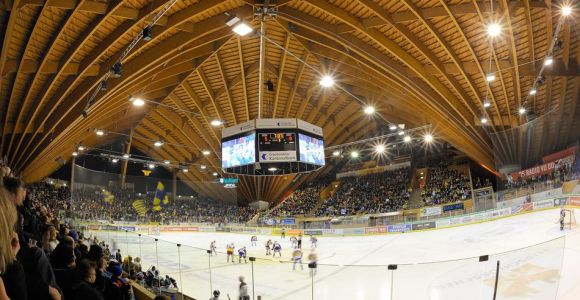
csm_C_1002_Davos_volle_Vaillant_Arena_Lovaas_DSC9545_43dfe12363

One of my favorite tournaments of the holiday season is the Spengler Cup. I’ve stumped for this tournament many times, not just because Vaillant Arena is a stunning site for the eyes, but also due to it being a land of, “Oh, that’s where that guy went.” The 2017 event has even more appeal to it, as there will be another national team aside from Canada to be featured right before the Olympics this year.

First, a bit of a history. The tournament itself is an invitation-only tournament hosted by HC Davos and created by Dr. Carl Spengler to help promote German-speaking European hockey clubs back in 1923. It was a way for those who felt ostracized after World War I to have place to play and have a communal feeling. Two teams who are constant are obviously HC Davos, but also Team Canada– which is a group of Canadian players who play over in Europe and are released by their minor league or college clubs to play in this event. Canada has been given an invite since 1984; while the other teams are filled out by other national teams and European club teams.

With this installment of the Spengler Cup, Canada’s team will have a last rehearsal for players want to represent the nation in the 2018 Games in South Korea. While there are plenty of former NHL players who play in Europe on the roster, it also has three players from the AHL (Jeff Schultz, Cody Goloubef, and Christian Thomas), as well as four players from the NCAA (Brandon Hickey, Jake Evans, Jeremy Davies, and Dylan Sikura). With five players back from last years championship team (Mason Raymond, Nick Spaling, Maxim Noreau, Andrew Ebbett, and David MacIntrye); the Canadians should continue to be a favorite in this event.

However, Canada isn’t the only team who’s scouting their Olympic roster as Switzerland will be fielding a team ahead of the Olympics. Some names that NHL fans may know include Damian Brunner, Tobias Stephan, and Raphael Diaz; but start to learn about goalie Leonardo Genoni. Genoni has had a history with the Spengler Cup with HC Davos, but it’s been one of hot and cold spells in this week long tournament. With the Swiss paired against Canada, South Korea, and the Czech Republic; taking on Canada and the other participants in the Spengler could give them a gauge on what they would need in order to have success in Olympics. A notable omission is goalie Jonas Hiller, who played in the Karjala Cup in November, but is not on this roster.

HC Davos, Canada, and Switzerland will be joined by Dinamo Riga of Latvia and the KHL, Mountfield HK of Czech Republic, and finally HPK Hameenlinna of Finland. There are times where teams will loan out players for this event– which HC Davos is taking advantage of with getting Jeremy Morin from SC Bern, Tomi Sallinin from Kloten, and Samuel Lofquist from EHC Biel. For Dinamo Riga, the likes of Danny Kristo, Karl Stollery, and Nikolai Zherdev are on their KHL squad and will most likely be at this tournament. Former King and Panther Jaroslav Bednar captains the Mountfield team, while Hameenlinna boost a young squad of players including former Bruins prospect Mikko Lehtonen.

It’s a quick and fun tournament that doesn’t get enough play in the US, even if there’s a US team in it like was the case with the Rochester Americans a few years back. If you’re in Canada, you can catch the action on the TSN family of networks; but in the US– good luck finding a totally legal stream of the event.

Time to Right the Schedule, AHL

avs eagles_1507731477059_11360269_ver1.0.png

With the announcement of the Colorado Eagles moving to the AHL, as well as the San Antonio Rampage announcing a multi-year affiliation deal with the St. Louis Blues, and barring any unforeseen circumstances with other teams around the league; the AHL team roster has been set for 2018-19 already– which is nice, but brings up some other questions, at least in my mind.

Of course, with Colorado being in there– the divisional alignment is going to be pretty straight forward. The seven teams west of Texas– Stockton, Bakersfield, San Jose, San Diego, Ontario, Tucson, and now Colorado– will mostly likely make up the Pacific Division. This will move the Texas Stars and Rampage to the Central Division, thus pushing Cleveland to the North Division. Simple enough. It also leaves some room for when/if Seattle gets a team and wants to put their affiliate in the Pacific Northwest with them.

The bigger question now is what to do with the schedule. With all seven teams on the equal footing, does the AHL finally pull the trigger on making those Pacific Division team play a full 76-game season or so they think that 68 will be smarter for all the teams, despite having their own division. In either situation, the idea of using percentage points as a deciding factor gets thrown out the window and really shouldn’t be the default playoff that always comes up on TheAHL.com.

My thought on this is that this is the perfect time to sell the 76-game schedule to the Pacific teams. Look, they had a nice run of playing eight less games, though it really hasn’t make much a different in the playoffs for them, but it’s time for the AHL to put their foot down and say, “If you want to play in our league now– it’s time to play by our rules and play the full 76-game slate.”

It’s an easy sell now. There’s seven teams in their division, they won’t have to make “big trips” to Texas to play and could find a way to still keep to themselves, but at the same time– actually be a part of the league in playing an actual full schedule for once. Hell, it’s almost paramount of the AHL to make this happen rather than keep letting them get away with the 68-game slate. If they keep doing that– who’s really in charge?? Why have these teams in the league, even with their full division within a reasonable travel destination, if they don’t play the same amount of games that the other 24 teams do.

As you know, this isn’t my first ranting piece about the AHL schedule, but I hope it will be my last. You can’t have a league that’s touting itself as the step-below The Show, if you have two different set of rules in terms of scheduling for the league. This is the time now to really show that the league is in charge and that eight more games against others in the league are going to be okay and the players will be able to get through the travel. If they want to make the show, they’ll have to deal with some travel here and there anyway– so why not get them used to it and have them earn their stripes (and their reward miles) rather then steal eight games away from there throughout the season.

On the Topic of Greg Wyshynski

With the news of Greg Wyshynski leaving Yahoo, it’s the end of an era for everyone in the blogosphere. 
I consider Greg a good friend and really an inspiration for working and what’s he’s been able to build up for the alternative media to the point where blogs are (in most cases) legitimate media for the NHL. 

On top of that, the community he’s been able to build and the people I’ve met through the Puck Daddy parties has been great and something that’s long lasting.

Whether it’s driving up to Airdrie after the 2011 Heritage Classic for steak or debating “Titanic” as an action movie, Greg has been a great inspiration and a bit of a marker to reach for. 

It’s not the end, of course, but this chapter he wrote was a great one and I’m sure the next one will be just as good. Here’s to you, sir.

On the Topic Of NCAA Expansion

NCAA-Ice-Hockey

With Penn State and Arizona State making the jump from Division I club team to Division I in the NCAA, it makes some wonder who is going to be the next team to make the big jump to the NCAA and who is really able to make the jump with few stumbles along the way.

During this year’s NHL Draft, the University of Illinois announced that they were the first team to participate in the newly sponsored research for the feasibility of more college teams being brought up to the Division I level of hockey. It would make sense for Illinois to be the first to be in this program, as the state is surrounded by plenty of college hockey and would have a built-in conference alignment in the Big Ten once they move into D1. In the ACHA, Illinois went 13-11-3 in 2016-17 and finished the season being ranked 13th in the final rankings. That ranking is up from their 17th final ranking in 2015-16 and even with their final 2014-15 ranking at 13th. Illinois has been a club team for 60 years and with the Big Ten finally getting a hockey conference, it could be time for them to make the jump to the big show.

That said, I wholly expect that the next team to get funding to see if their program is viable for NCAA D1 status will be the Naval Academy. You can bet that the NHL and NHLPA will announce that during the Stadium Series weekend in Annapolis, as well.

The location of Illinois would be perfect when you look at the map of the NCAA. It’s clear to see that if you’re a D1 hockey school, you’re probably in Northeast corridor or the upper Midwest. Only two of the 60 NCAA D1 schools are south of the Mason-Dixon line (Miami-Ohio, Alabama-Huntsville) and seven teams are west of Minnesota (North Dakota, Colorado College, Denver, Air Force, Arizona State, Nebraska-Omaha, Alaska-Anchorage, Alaska-Fairbanks) with the two Alaska teams on thin-ice with keeping their teams due to financial reasons.

With the look at Navy, the move would help the NCAA establish a move towards the under-represented Mid-Atlantic region of the US. On top of that, the team would have already have the two other service schools– Air Force and Army– as their rivals. McMullin Arena may be one of the smallest of the NCAA, but they would be in line with what Robert Morris University has with the majority of the stands being on one side of the rink rather than a bowl seating situation.

There are some issues with Navy getting in and being competitive from the start, with recruiting being the biggest issue, which are the same issues that Army and Air Force deal with when it comes to bringing in the top players into the program. With players having to do service time after their college career is done, some may be hesitant to joining the team.  This is something that former Army goalie Parker Gahagen is dealing with, as he signed an amateur try-out with the San Jose Sharks, but is not looking into whether or not he could defer his service time (a minimum of two years) to move on with his NHL career. The same thing happened with Zach McKelvie after he finished his Army career, but had his pro hockey career stalled due to having to finish his active duty time in the Army.

However, the move to the Mid-Atlantic region for NCAA D1 hockey would be great for the high school scene in and around that area. While there are great club teams who play in that area and have a history behind them, it’s an underserviced area of the US when it comes to the prospects of high school players playing close to home. Especially with Alex Ovechkin having an impact in registration for youth players in the Maryland/DC/Virginia area, you’d think the NCAA would want to tap that market, too. Both Sam Anas (Quinnipiac) and Jamie Fritsch (New Hampshire) were Maryland kids who were able to break out and have D1 careers, but for the most part, a lot of players in the area look to the club team’s D1 or hope for a NCAA Division III school to go to– which isn’t bad, but you’d think they’d want to strive for move and try to get that boost to D1.

While Navy would be a good fit to the NCAA D1 pool, the University of Delaware could be another option. While not the most sexy of choices, the pool of players they can pull from would be tremendous as they would have Philadelphia and Southern New Jersey players to recruit and be close to home base. Delaware’s D1 club program has been a model for consistency and has won an ACHA National Championship in 2012, the first for the program. The team would fall into that Northeast corridor area of travel, but be a little closer for kids in surrounding states who don’t have D1 college hockey within a reasonable driving distance. While they did run into trouble last season, having to pull out of the season due to school sanctions, the team was reinstated by the school without having to miss a season because of said sanctions.

This whole scenario doesn’t include the growth of hockey out west, especially in California and Arizona. With Arizona State making the jump, they may have started a westward shift, but without any club teams (sans University of Arizona) being all that prominent in Division 1 of club hockey, it will take a little more time to grow the college game out there. The whole point is that right now, NCAA hockey is a big area of development for NHL teams and more and more kids from different areas are getting involved. It’s up to the NCAA to maybe explore harder into what they need to do to expand past the 60 teams they have now and make it viable. Assistance from the NHL and NHLPA will help greatly, but the NCAA can’t rely on those entities, as they will only look for area that would also help in NHL markets rather than outliers.

 

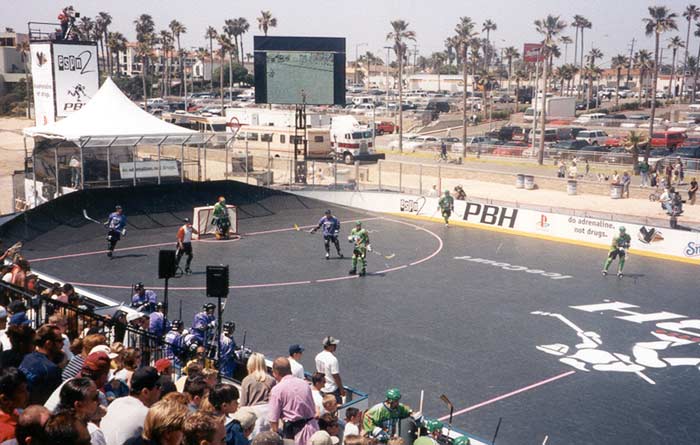
Trying to Get Your Roll Back On

maxresdefault.jpg

In the last installment, I talked about the NHL Street initiative and how, while still active, doesn’t get enough the rub it should. This installment, I’ll talk not only about the NHL involvement in roller hockey, but the lack of another big roller hockey league or spectacle in our sporting lexicon these days. Sure, I tackled this topic seven years ago, but it bears repeating.

I mean, did you know that there was a World Inline Hockey Championship held in Slovakia in June?? Yeah, me either until I looked on the IIHF’s website about it. The game of inline hockey doesn’t have the heat it once did and it’s almost a shame due to a lot of teams being climates where kids really got into the game by roller hockey being the first means of hockey.

The inline boom happened in the ’90s with Rollerblade being the big company to start capitalizing on it and becoming the Kleenex and Hacky Sack of the generation with the brand being referred to as the activity. Dennis Murphy– who created the WHA and ABA– thought it was time to really get inline hockey into the forefront. That’s how he came up with Roller Hockey International.

With the exposure on ESPN, RHI got a decent following, which was helped with the expanded amount of teams in warmer climate areas with kids who played roller hockey in their communities. RHI had teams everywhere from Vancouver to Miami, but there were plenty of ebbs and flows and movement that made the league become extinct by 2000. However, they did have plenty of NHL power with the likes of Brian Trottier, Tiger Williams, Manny Legace, and Peter Skudra having their time in the RHI.

As the RHI winded down, ESPN had saw what roller hockey could do and draw, so they teams up with David McLane and came up with Pro Beach Hockey. As wild and gimmicky as it was, PBH stood out because of it. Using a ball instead of a puck, playing outside, RAMPS BEHIND THE FRIGGIN’ NET— this had it all. While it only lasted three years because ratings weren’t what ESPN wanted, people still have some recollection of it 17 years after it ended.

Also towards the end of the ’90s, the NHL had their NHL Breakout tournament where they would go to NHL cities, put up an inflatable rink on the weekend, then the teams would come, compete, and that’s that. It was much like how the CBC Play On is today, but with inline skates on rather than just on feet.

While there is a league in Major League Roller Hockey that has some kind of “professional” format to inline hockey, the fact remains that the push it once had has been overshadowed just due to interests waning. Roller hockey has even a club hockey following in colleges around the US. You’d think, however, that with outlet like Twitter, Facebook, and YouTube having live streaming options; someone would think to stream a game and maybe draw some interest into roller hockey again.

Whether or not the roller hockey craze can come back remains to be seen, but in an off-season like this where nothing drastic has happened since the Expansion Draft– maybe hockey fans needs a roller hockey league or some street hockey events to get into and get interested in for them to make the summer months go faster.

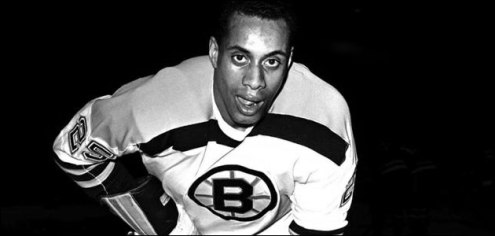
Willie O’Ree vs. the Hockey Hall of Fame

willieoree02

Another year has past and it’s another year that Willie O’Ree did not get his call to the Hockey Hall of Fame. It’s also a time where people, while joyed about other players, scratch their heads when it comes to the player who broke the NHL black color barrier (Larry Kwong being the first to break the color barrier in 1948) not being enshrined into the Hall of Fame for the sport. There’s one simple answer to this:

The Hockey Hall of Fame voters are short-sighted and protected by their voting process not being revealed.

That said, they seem to only look at him as a player who played only 45 games in the NHL, while playing almost 800 for a then rival league in the pre-junior Western Hockey League. In the old WHL, O’Ree had 328 goals and 639 points. While it is the Hockey Hall of Fame, it’s few and far between when someone who did not make an impact in the NHL gets into the Hall. However, in this case– there’s a caveat to it all.

Put Willie O’Ree in the Hockey Hall of Fame as a Builder.

The HHOF looks at a builder to be one who contributes to the growth of the sport. There’s been no one who has done that as much as O’Ree, even after his playing days are through. Hell, you can say that since he retired in 1979, he’s been more involved in getting Afro-Americans and Afro-Canadians into hockey than he was while he was playing.

To this day, O’Ree is spoken about by players like Joel Ward and PK Subban about the impact he had on them when they were growing up, even though they probably didn’t see much footage of him playing. O’Ree is the ambassador for the NHL’s “Hockey is for Everyone” initiative and serves as the director of youth hockey for the NHL Diversity program. The footprint he has left outside of the sport, decades after his last shift, is something that never seems to be taken into account when it comes to the Hall of Fame voting.

When you don’t have the person who not only broke the black color barrier in the NHL, but still continues to spread the message of hockey to the Afro-North American community in the Hockey Hall of Fame, there’s not a lot of slack you’ll get from people about it. Especially when you have the ability to put someone into the Hockey Hall of Fame as a Builder. There’s no one who has help build the game of hockey in different segments of the US and Canada as O’Ree has and continues to do.

Don’t make the same gaffe you did with Pat Burns, Hockey Hall of Fame voters. Let’s be able to celebrate the life and times of Willie O’Ree while we still have him around to celebrate with.

Fixing the NHL on TV: NHL Awards

In this format, I’m going to see what could be done by the NHL to help their off-ice product hit a little more with viewers and actually have people give a damn about what they throw on there. Also, what could actually be put onto the NHL Network or NBCSN or wherever and really hit hard. 

0422-nhl-awards17

I mocked the NHL Awards. I mocked it hard. I mocked it when broadcasting.

Outside of NASCAR, I think it’s the NHL is the only sport that has their awards banquet televised (EDIT: The NBA is putting their awards show on TV for the first time this year). To be honest, it’s very unnecessary and with all the dull sketches, terribly written banter, and awkward moments– shows that it doesn’t need to be on TV at all. But, if the NHL insists on broadcasting it– here’s some things to make it better.

POINT 1: Put it on NHL.TV: The TV aspect doesn’t work. Only 2.3-million people watched the Awards show across the three networks covering it. The fact you needed to actually span this out along with the Expansion Draft showed that no one cared. If you put this all on NHL.TV, not only do more people have to log onto the site and bump those pageviews, but it’s not a big thing for the ratings bug that the NHL, NASCAR, and WWE overly care about.

POINT 2: Don’t force celebrity hosts: Joe Manganiello is a lot of things, but a host of an award show, I don’t think he is. Of course, not entirely his fault, but there were so many other people that hockey people know that could have been in that position. Though, any team who has a host that pays attention to him would go over the top with that stuff, like Manganiello did– hell, if I was host and the Caps won, I’d be intolerable. But Jay Baruchel would have been great in that role, rather than a presenter, hell– put a host of the NHL on NBCSN or Sportsnet there; like Daren Millard or Liam McHugh there. Sure, they aren’t funny– but it’s not meant to be funny. Just put people out there who know how to move from one part to another in an almost seamless way.

POINT 3: Lessen Awkward Moments: Look, that Marcel Dionne thing is bad….like, Joe Namath bad. You know what could have helped that?? Not having odd-ball presenters that don’t have any kind of tie to each other or just meet seconds before they go out on stage. Sure, it’d be boring and all that, but if people know each other– you can have the awkward moments not happen and if there is a bind, they can get out of it better than most. Or just have the host be the presenter of every award, too.

POINT 4: Don’t give them away beforehand: I know there’s some awards we don’t care about as a whole, but if you have to give them away the day before– maybe they’re not worth giving away. Sure, the Expansion Draft helped bump those awards to the day before but maybe they were test driving awards not being televised. Sure, one of the awards was the Mark Messier Award, but as long as someone cares about winning it– they should get the accolades in front of the crowd rather than random assembled media. Of course, they shouldn’t have gotten bump– which leads me to….

POINT 5: Don’t combine anything with it: The Awards should be special and by putting the Expansion Draft with it lessens both allure. There was no need to combine them, especially when you saw how awkward Bill Foley and George McPhee looked on stage during the whole thing. Let the Awards breathe and speak for themselves. No need to mix anything with it.

POINT 6: Enough with the music: There’s no need for the Arkells to be there. I’m sure they’re great in their own right, but I’m sick of the music that the NHL throws at events that hockey fans are pretty “meh” about. Look at Neon Trees at the Draft Fan Fest this weekend– they were a “meh” pick. Is there a need for music?? Probably not– so let’s do away with it except for the All-Star Game and maybe the outdoor games.

Okay, that’s that– it’s the summer and it’s going to be stuff like this that could make things better or marginally watchable. That’s all I want to convey.

My Knights?? MY KNIGHTS!?

finaldraft

It’s what you’ve all been waiting for….and by all, I mean none. It’s my draft list.

A couple of notes– yes, all the trades for Draft picks will mess a lot of this up, as well as side deals. However, the side deal I know will happen (I hope) is that the Capitals make a deal to have George McPhee pick Brooks Orpik to get that contract off the Caps books, but in return, the Caps have to part with a young rostered defenseman, a prospect, and a pick. Steep price, but since they can’t trade the Orpik contract, they need room for elsewhere.

I’m sure this is 100% wrong, I don’t care. Let’s just have fun with it and move along to simming how they’ll do via NHL18.

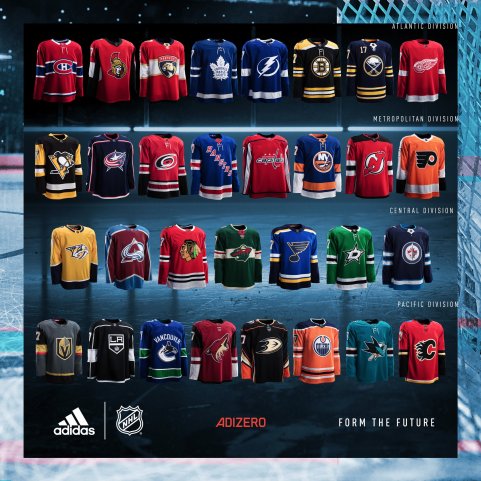
TEPID TAKE: Jerseys Aren’t THAT Bad

DCz1hVjV0AI6GtK

Look– the Nashville Predators jerseys are bad. Like…Sears Christmas Catalog looking bad. But, for me, it’s really the only one that stood out as truly awful in the new Adidas Adizero jersey reveal. The rest of the looks are pretty much the same, but the design of them brought about pretty big reactions. Of course, the Vegas Golden Knights finally getting an identity was a huge get, too.

There are some things I’m annoyed by already by Adidas, one of which is the designers calling them “tops” instead of jerseys. I know it’s just a lingo thing, but if we’re going to try to keep some tradition, let’s keep it at jerseys. Also, some teams stealing the NBA gimmick and putting the Stanley Cup years into the collar just doesn’t sit right– looking at you, New Jersey.

However, there were improvement to me. The Avalanche going back to their old design is a massive upgrade over the tripe they’ve had to deal with the past couple of years. Only when the third jerseys are back will they have a chance to ruin their identity again– but for now, they get a nice pass. The Hurricanes also reverting back to the old school and reintroducing the storm flags is a nice touch.

The biggest thing going in was the Vegas Golden Knights uniforms. Overall, they look like something the German National Team would wear. It’s a nice look, don’t get me wrong, but doesn’t scream Vegas to me. The white gloves with gold cuff and fingers does scream Vegas to me, which I’m glad they were brave enough to make that change and make white gloves not just for All-Star Games anymore.

Overall, the jerseys are kind of buy the book, with the exception of the Minnesota Wild hacking onto the Canadiens mid-stripe look. The biggest thing to overcome for me is going to be collar area, which everyone got a preview to in the World Cup of Hockey. I’m sure they’ll look better on the ice and grow on me as the Reebok Edge eventually did.