UND HOCKEY: Fighting Hawks Tie Bemidji State to End Non-Conference Schedule

DTeK6oMU8AAGMOM

Photo via @UNDMhockey

GRAND FORKS, ND– After going to Bemidji State and winning 5-1, the University of North Dakota traveled the 120-some odd miles back to the Ralph Engelstad Arena to face the Beavers in front of 11,868 on Saturday. Tired legs and long nights lead to a 2-2 tie between the two and brought a bit of an anti-climatic end to UND’s non-conference season.

The Fighting Hawks weren’t without their issues, as Rhett Gardner and Trevor Olson were both out due to injuries on Friday, but the team soldiered on as they often do. North Dakota didn’t let the odd travel schedule lag them down, as they were on Bemidji from the drop of the puck. Putting plenty of rubber towards Michael Bitzer, but yielding no results. Bemidji did a solid job keeping UND to the outside and with the Fighting Hawks not able to crack the middle, any threat of a rebound to the slot was directed away by the Beavers’ defense. Shots ended up 12-3 on the side of UND.

UND kept cracking at it to start the second, only to break the ice 3:28 into the frame as Nick Jones came in from the slot after Austin Poganski took a skate around the net and found a streaking Jones, who netted his third goal of the weekend. While shots were traded by and forth, it wasn’t until 13:15 in the middle frame where Leo Fitzgerald got a stick on a Brendan Harris shot on the power play to tie the game at one. Right after the goal, however, Bemidji’s Jordan Heller got a five minute major and a game misconduct for checking from behind. The extended power play was needed, which got the first goal as Christian Wolanin took a skate around the zone, saw the puck passed around until it found his tape again from a pass by Collin Adams to make it a 2-1 UND lead. Despite having control of the power play for a majority of the five minutes, they could only find the net once.

The Beavers pushed hard in the third, but didn’t have many shots to show for it. However, Bemidji knotted the game up after an odd bounce off of Dillon Eichstadt and Colton Poolman’s skate before going into the net past Cam Johnson. Eichstadt got credit for the goal with Kyle Bauman getting the assist. The play stayed at neutral most of the time, with Bemidji getting a little more pressure on Johnson than UND did with Bitzer, which caused free hockey for everyone at The Ralph.

The overtime period had plenty of chances for both sides, Bemidji’s Leo Fitzgerald getting three good looks, while UND had Austin Poganski and Shane Gersich getting back-to-back chances, but yielding nothing at the end. The game ended with a tie and having UND go 6-2-4 in their non-conference schedule.

“I thought we played well those non-conference games,” said head coach Brad Berry. “Overall, it was respectable. We gotta make sure we play a consistent brand of hockey in the NCHC and get in the National Tournament.”

“We take non-conference games very seriously,” mentioned Christian Wolanin. “We know how important they are at the end of the season. But we geared up and gave it our all for every season and I hope that it helps us in the pairwise.”

With the line-up card tonight, it was UND’s 24th game with a different line-up. Players like Wolanin and Jones had never seen something like this in their playing career before, but Jones was able to put it in perspective post-game:

20180113_214329.jpg

Nick Jones/Photo by @NHLHistorygirl

“I don’t think they’re challenges, I think they’re positives. At the end of the year, you’re not going to have everyone you’re able to have. To have the opportunity to get everyone in the line-up and ready for the end of the year. Our ultimate goal is to win a National Championship and we’ll use it as an experience. In the end, it’s rewarding for every player and a fight to get into the line-up every night. It’s something we can use to our advantage.”

The Fighting Hawks go to Minnesota-Duluth to play the Bulldogs next weekend and are back home on the 26th for a weekend set with Denver.

UND Hockey: Mavericks Ground Fighting Hawks 4-1

DS1FhSYW0AMcLVn

GRAND FORKS, ND– The start of the second half and back into conference play was a rocky one for the University of North Dakota, who lost to the University of Nebraska-Omaha 4-1. A crowd of 10,133– the smallest regular season in-conference game crowd at the Ralph Engelstad Arena since January 2004– saw the Fighting Hawks come out a bit slow and get out worked by the Mavericks.

While Omaha was last in the NCHC coming in, they got off to a jump early with solid chances, two ringing off the post. The speed of UND was able to crack the defense of Omaha, but couldn’t get much on Evan Weninger. A turning point of the period was a holding call against Christian Wolanin of UND, but added to it was jawing to the ref, which resulted in a 10-minute misconduct. During that PK, UND had two good chances, but couldn’t connect. Omaha’s solid first culminated with Fredrik Olofsson using two UND defenders as a screen to put home his fifth of the season. Late in the first frame, Shane Gersich broke away, which led to Grant Gallo pick-axing Gersich in the shoulder to warrant a penalty shot. Gersich made the most of it to pot his sixth of the season and tie the game.

“First period, we didn’t have the quality chances we could get,” said coach Brad Berry post-game. “One of your most offensive guys is in the penalty box and you’re down to five D, it starts there. Then you get down to a little frustration and getting down and trying to come back again.”

North Dakota took it to Omaha to start the second, but thanks to a power play in the middle of the frame, Omaha took advantage as Luke Nogard poked in a Zach Jordan centering attempt to sneak by Cam Johnson and give Omaha the lead. The goal was the first shot that Omaha registered in the period, which took them 8:20 to get. Omaha took a 3-1 lead after David Pope hammered home a Ryan Jones set-up pass, which went through a mass of humanity in front to beat Johnson.

The third saw UND not give as much jump as they needed, with their best chance coming from a Matt Kierstad breakaway that Weninger stopped blocker side. In the middle of the frame, Kierstand overskated a pass, which allowed Zach Jordan to break-in and go high-glove on Johnson to make it 4-1 Omaha, which was the final score. Weninger finished with a season-high 34 saves in the win.

“We will change the line-up, we will make changes in our lines,” mentioned Berry. “It’s one of those things where at this time of year, you’re hoping you can solidify some things, but I guess we have to keep moving forward and get some information on some things to see what will work.”

“We have to play more simple,” said defensemen Colton Poolman. We weren’t playing good defense. They outworked us. We had a couple good days of practice, felt like we were ready in the locker room, but it didn’t show up on the ice.”

UND will look for a split on Saturday, hoping to contain the fifth highest scoring team in the NCAA.

Marylander Giles Helping Non-Traditional Developmental Area Get Noticed

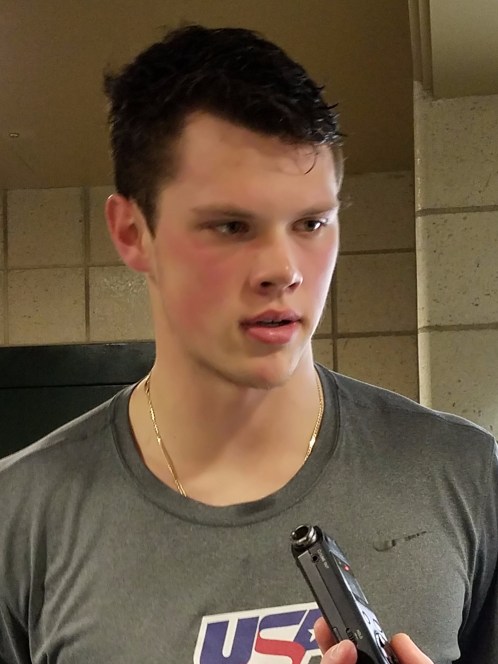
20171230_213509

Patrick Giles/Photo by @NHLHistorygirl

It may not come as a surprise to you (especially with my rantings on it), but Maryland isn’t the biggest hockey factory in the USA. In fact, some would think it’s one of the outliers despite the Washington Capitals being around in the area for over 40 years. The thing is that it hasn’t been until recently that there has been a surge of players who come out of Maryland that weren’t sons of Capitals players.

One of the players who are leading the charge for the younger ages Maryland players is Patrick Giles. Currently playing with the US National Team Development Program, Giles left Landon School after his sophomore year, which is very unheard of when it comes to Maryland players. Sam Anas, who also went to Landon, played all four seasons before moving on with Quinnipiac University and then to an NHL contract.

“Leaving Landon was hard, especially with all my friends there,” said Giles after the USNTDP game against North Dakota. “The coaching there was phenomenal for Maryland hockey. They definitely helped me with my development and get where I am today.”

Of course, for a 16-year-old to get up and leave high school is fairly hard, but when it’s going for your dream– it’s a risk you have to take. When given an opportunity like Giles was given, one would have to leap to a chance; though not without a lot of thought put into it.

“It was tough at first,” Giles remember,  “But, after I got the call that I made it, it was pretty easy because it’s such a big opportunity and I couldn’t turn it down. But it was definitely hard to leave my family.”

While there has been a number of players to play college from Maryland, especially in Division I recently, Giles is getting a bit of a head start with the U18 USNTDP program. The team does participate in a partial USHL schedule, as well as international tournaments, but the team does face-off in exhibitions against Division I and Division III schools to see how they fare and stack up. With many of those on the U18 team already committed to D1 schools, it’s a good test.

What’s great about this team is it gives us the experience to play against top colleges,” mentioned Giles– a Boston College commit. “It lets us ready for college and wherever else we may decide to play in in the future.”

While the team is made up of other college commits, it’s also full of draft eligible players. The likes of Auston Matthews, Jack Eichel, Seth Jones, and Rick DiPietro have been through the NTDP system and been top draft picks. However, Giles and his teammates don’t seem to be concerned with that saying that they really just focus on the next game. However, if he does get drafted– he’d be (by my count) the fourth Maryland-born player to be drafted into the NHL– Jeff Brubaker, Jeremy Duchesne, and Graham McPhee being the other three.

With Giles, along with Adam Varga in the OHL, paving the way for Maryland to perhaps become more visible on the prospect-front and have more kids not have to go outside the state in order to get noticed. Giles takes it to heart and takes pride in being from Maryland.

“Coming from Maryland, a couple of guys have gone the same route,” said Giles. “Just being from a non-traditional market like Maryland, it’s been great to have the support for my state and from my family. It’s been a great experience for me.”

Fixing the Minor League System

maxresdefault

Photo taken from N2B Goal Horns’ YouTube (https://www.youtube.com/watch?v=-BCELxhOAFw)

Yesterday, I talked about the Draft system in the NHL and how it is a broken system when it comes to the player’s rights and actual development with the team overall. However, the only real way to fix this system is to totally overhaul the minor league system as we see it today.

The idea to have a 31-31-31 system is a great idea for hockey– but are there 93 markets out there that are strong enough to keep things solidified for a decent amount of time and are there enough prospects out there to fill that team and make the pipeline system viable and valuable overall to the landscape?? You can say that there are a good amount of markets that are stable as hell, but you can’t assume that all 93 markets will be very strong if they stay across three leagues.

First, you have to make the minors mean something– especially if you change it to a point where players have to choose between their amateur status (in a world with Major Juniors is considered amateur and you have to leave there to start a pro career) and their pro career starting. You’d need a strong first step. Elements need to be taken from the SPHL– not saying that they’d be a jumping off point, but their regional presence is something that minor leagues need more of.

Second, take that regionalism and then create leagues that way. The problem with minor league hockey in the late-90s/early-00s is the fact that while there were a wide array of hockey leagues– they were all in competition with each other trying to be the Alpha League. The ECHL was in competition with the WCHL, UHL, CHL– but ultimately the ECHL won out. The AHL had to compete against the IHL, but the IHL’s owners were too enamored with competing with the NHL that they lost the plot and then the AHL won out.  The thing in this day in age– especially with a stress being put on development– is to take a page out of baseball and have multiple minor leagues in different regions, but a uniform classification for them to battle it out playoffs wise; almost like the NCAA and their conferences.

(In this scenario, amateurs are in my consideration Major Junior and NCAA, with the same rules applying that if you declare and sign a pro contract, you can’t go back to those teams– as a point I suggested with the post on Thursday. You can bet that the CHL will have plenty of push-back on that because they’re trying to run a youth-pro league off these kids; but it’s my imaginary situation– so get over reality for a bit.)

As great as the SPHL has been– they almost have to be considered independent to this whole scenario I’m putting together since I don’t believe there’s any official affiliation with the NHL and the SPHL clubs. Not only that, but I doubt there’s enough prospects for each team to sustain quality hockey across 31 Single-A teams. The SPHL is better off as its own entity anyway because they wouldn’t be held to the hard and fast rules of the NHL in their trickle down theory.

Therefore, the current ECHL is the entry-level point for players who declare and sign their pro contract. However, you can’t have the ECHL as one league anymore– you almost have to have the two conferences as two leagues under the AA banner of hockey. Hell, if they really wanted to get into it– make it three leagues under the banner and then the top teams meet in a final eight– the two top teams from each of the three leagues and overall wild card to win the AA title.

When it comes to the AHL– or AAA level– you can do what baseball does since teams are moving more westward with their teams. Especially with Loveland, Colorado coming into play next season, it just adds to that flavor. Again, you could have three leagues with an Eastern, Midwest, and Pacific leagues under that AAA banner to have all three meet akin to what I suggested with the AA league.

While minor league hockey does have its niche, the fact that people believe that one league is needed seems a little stupid, especially with how the NHL made sure to move their teams closer to them and then held the AHL hostage to make their games/travel less than the rest of the league or they threatened they would start their own league. In all honesty, they should have started their own league and started this upheaval quicker than what I’m suggesting.

Granted, some teams in some areas may want promotions, but at the same time– it’s knowing their market and knowing what they can be capable of doing in those markets with that league. An idea of relegation or promotion– which is sexy in a gimmick sense– won’t do much for stability in a cutthroat business of sports. It’s a nice idea, but when put into reality does more harm than good.

There’s a lot to enjoy about minor league hockey– but when you look at a successful and sustainable league, the regionalism of the SPHL is the front-runner for solid business model. They know their communities, they know their role in hockey, and they don’t get too ahead of themselves thinking they’re going to be the next big thing. They play to what they know and it pays off for them overall. If all minor leagues and minor league teams could see that and realize that regional hockey is a solid money maker/travel saver– then the divided leagues under the same classification could work out very well in order to save minor league hockey decades down the road.

On the Topic Of Marylanders in College, Junior, and Pro Hockey

If you have followed along in my life, Maryland is a huge part of it. After living in Glen Burnie for 21 years, obviously there’s a sort of pride there. But recently, I’ve seen an influx of Marylanders getting into the pro hockey ranks, as well as Division I NCAA and Major Juniors. With it being a dormant landscape for hockey, it’s always a fine sight to see a kid from Maryland get noticed on a big stage.

236-nick-ellis

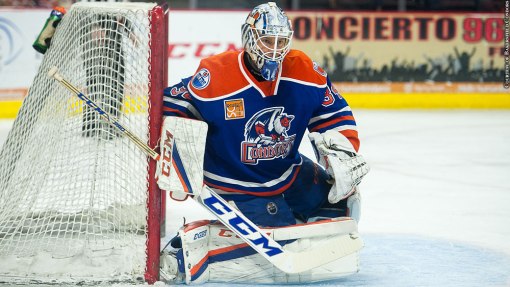
One of the bigger ones recently has been Nick Ellis of the Bakersfield Condors. The Millersville native was signed by the Edmonton Oilers as a free agent after three years at Providence College where he posted a 30-9-5 record with a 1.90 GAA. Earlier this year, Ellis got AHL Player of the Week honors and has been put into a bigger role for the Edmonton affiliate.

Another player to possible get buzz this year or next is 16-year-old Adam Varga. After playing for the Washington Little Capitals U15 team, Varga took an unorthodox step by jumping to Major Juniors and signing with the Mississauga Steelheads of the OHL. While there are territorial disputes of who’s a Marylander and who’s not (more on that in a second), but my count he is the fifth Maryland-born player to play in Major Junior after Jeff Brubaker (Hagerstown), Jeremy Duchense (Silver Spring), Charlie Pens (Perryville), and Campbell Elynuik (Silver Spring) to be stated as Marylanders in Major Junior. It’s a big step for hockey in Maryland and how the development is, as most Maryland kids go the NCAA route or even the Division III route for their higher-level hockey.

However, there is a bit of a conflict when dealing with player bios because some players will put somewhere else outside of Maryland, while other sites will post Maryland as their hometown. Elynuik is a perfect example as he is listed on HockeyDB as being from Silver Spring, but Elite Prospects will have him listed as being from Calgary, Alberta. Jarred Tinordi is another example, as he was born in Burnsville, Minnesota; but made his hay in Severna Park, Maryland– playing for Severna Park High School in his first year before going to join the US National Developmental Team. A guy like Michigan State’s Jared Rosburg is a whole other can of worms. Rosburg is listed as being from Clarksville, Maryland, but grew up in Strongsville, Ohio. Since he played for River Hill in Howard County, I’ll chalk Rosburg up to one of Maryland’s own.

(Elynuik, Tinordi, and Duchense bring about another example of guys listed as being from Maryland thanks to their father’s playing with the Washington Capitals when they were born. While Tinordi did play within the area, the others didn’t make that big an impact, especially with Duchense living in Quebec City for the majority of his youth.)

10.2.16_MSUHK

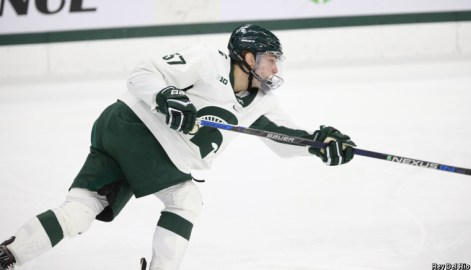
Rosburg is one of many players who have touched NCAA Division I ice while being listed as a Marylander. The Michigan State defenseman has dealt with injuries, but has been a big presence on the blue-line and has come up with some big goals in his short career. Rosburg is following in the footsteps of Sam Anas, who is recently the most successful Maryland player, as he’s been in the Minnesota Wild organization for two years after a successful NCAA career at Quinnipiac after a solid high school career at the Landon School in Bethesda. Of course, Anas goes in that disputed Maryland/Washington DC zone where both sides want to claim him. Colgate’s Bruce Racine is in the disputed zone of Maryland/DC, as he was born in DC, but went to school in Bethesda at Georgetown Prep. Other NCAA players for the 2017-18 season are Matt McArdle (Annapolis/Lake Superior State), Colin O’Neill (Odenton/UMass-Lowell), Jason O’Neill (Odenton/Providence), and Graham McPhee (Bethesda/Boston College).

In the minor leagues, outside of Ellis and Anas; there are several others playing in the lower minor league ranks. Jack Burton was born in Reisterstown and went to Baltimore-area St. Paul’s school before heading to Colby College and then joining the Indy Fuel last season, where he is today. Another Maryland ECHLer is Nick Sorkin of the Wheeling Nailers, who played for Team Maryland and the Washington Little Caps before going to University of New Hampshire, then to the Nailers. Former Glenelg High School player and Woodbine native Eric Sweetman is in the ECHL, as well, playing in Idaho after four years at St. Lawrence University. Mike Chen played for Team Maryland growing up before heading to Division III at Salem State and is currently rostered on the Knoxville Ice Bears of the SPHL.

Women’s hockey has also grown in Maryland, especially with the likes of Haley Skarupa being from Rockville and playing on the US Women’s National team, as well as in the NWHL with the Connecticut Whale and Boston Pride after four successful seasons at Boston College. Beth Hanrahan of Poolesville played four years at Providence College for four years, being the team’s MVP in her junior and senior season, then playing for the New York Riveters before being name associate coach of Lindenwood University. Finally, Lindsay Berman of Odenton starts her third season as head coach of UMass-Boston’s Women’s team after her years in the CWHL with the Boston Blades, including a Clarkson Cup championship to her resume. Berman went to Arundel High School and played for the Washington Pride to garner attention leading her career at Northeastern University.

I’ve said before about how Maryland and the mid-Atlantic has been underserved as a market, especially with no NCAA program in the state. However, there’s a new wave coming through, especially with Varga in the OHL and young Patrick Giles (Chevy Chase) joining the US National Program; there’s a lot of shoot for in the youth programs in the Maryland (and sure, DC) area, though the high school systems does have a variety of teams. Also, the club hockey scene does have a lot of talent, but still not the top-tier talent other areas have. The area is still in need of more success stories, but I know I didn’t think in a million years there would be this much Maryland content across the NCAA and minor pro landscape as there is today.

UND HOCKEY: Depth Will Be Key to Hawks Success This Season

und-berry-051815

When it comes to this season, North Dakota head coach Brad Berry has quite the problem– but it’s one that he is probably glad to have.

“The difference of this team from the teams the past two years is the depth. It’ll be a challenge on a nightly basis to put a line-up together, and that’s a good thing,” Berry said during the annual UND Media Luncheon on Tuesday. “There’s going to be a lot of competition to be in our line-up night in and night out.”

Depth is something they might need. With the big losses of Brock Boeser, Tyson Jost, and Tucker Poolman, on top of the graduation Gage Ausmus left some holes in a line-up that was a bit of the envy of most teams in the nation. Yet, this year– the Fighting Hawks are without a 1st Round Draft pick on their roster and will really show off their character and make a name of themselves where there’s few big names to be found.

While it is out with the old, it’s definitely in with the new. Eight top-notch prospects are coming into Grand Forks with plenty to prove– especially Nick Jones, who is playing after sitting a year out after transfering from the Ohio State University. One of the most hyped players is Grant Mismash, a recent draft pick for the Nashville Predators and is another player to filter out of the US National Developmental program. Peter Thome could also be someone who battles incumbent netminder Cam Johnson for playing time at some point through the season.

“We have eight guys coming in, but one of them is a junior– so I can’t call them all freshman. We have one true freshman in Grant Mismash who is coming out of high school, but we have four guys who are 20-years-old and have some experience at the Junior A level, so they’ll be a huge part of our leadership going forward,” remarked Berry.

However, it’s all about not only how you start, but how you finish. Last year, UND was the tale of two teams. Though they started out of the gates quick, the hangover of a National Championship caught up to the Hawks. With struggles in the middle of the season thanks to injuries to Boeser, Jost, Poolman, and Johnson to name a few– the young team had to step-up quickly and find a way to develop even quicker.

“We started out of the gates last year strong going 5-0, but then we ran into senior-heavy teams like Duluth and Minnesota that kind of gave us a wake-up call,” said Berry. “We felt as a staff, we were playing the best hockey all year in the last two months of the season going into the national tournament. The NCHC, you all know what it’s all about. It’s a very tough league, but it helps us get prepared. Anyone who comes out of this schedule will have a great chance to hang a banner at the end of the year.”

While they stress the NCHC schedule, non-conference games are what Berry thinks the team needs to put a lot of stock in, as they go up against the Pairwise Rankings when it comes to at-large bids for the National Tournament. Yet in that time, it’s nice to have some of the old guard to come back and let this young team see the shoulders in which they are perked up on.

“We’re going up to Anchorage. We haven’t been up there in a number of years, but I think it’s going to be a good team bonding situation for us,” said Berry. “When we get back, we’ll be home to St. Lawrence, but what’s special about that weekend is that we’ll be honoring the 1987 National Championship team for a 30-year reunion. Guys like Eddie Belfour and Tony Hrkac will be back and it’ll be great to honor the foundation of our program back in our building. It’ll show the guys here what it take to win a National Championship and that that time passes by fast. We won the National Championship two years ago, but next thing you know– they’ll be back for their 30-year reunion. It’ll be a special weekend.”

Berry knows that his players needs to know that this season, while it may go quick, will be a marathon.

“When we open up against Manitoba this weekend, we’ll know a little more about our players and our depth. After that you have to stand by the process in every game and every practice and not get too ahead of yourself.”

On the Topic Of NCAA Expansion

NCAA-Ice-Hockey

With Penn State and Arizona State making the jump from Division I club team to Division I in the NCAA, it makes some wonder who is going to be the next team to make the big jump to the NCAA and who is really able to make the jump with few stumbles along the way.

During this year’s NHL Draft, the University of Illinois announced that they were the first team to participate in the newly sponsored research for the feasibility of more college teams being brought up to the Division I level of hockey. It would make sense for Illinois to be the first to be in this program, as the state is surrounded by plenty of college hockey and would have a built-in conference alignment in the Big Ten once they move into D1. In the ACHA, Illinois went 13-11-3 in 2016-17 and finished the season being ranked 13th in the final rankings. That ranking is up from their 17th final ranking in 2015-16 and even with their final 2014-15 ranking at 13th. Illinois has been a club team for 60 years and with the Big Ten finally getting a hockey conference, it could be time for them to make the jump to the big show.

That said, I wholly expect that the next team to get funding to see if their program is viable for NCAA D1 status will be the Naval Academy. You can bet that the NHL and NHLPA will announce that during the Stadium Series weekend in Annapolis, as well.

The location of Illinois would be perfect when you look at the map of the NCAA. It’s clear to see that if you’re a D1 hockey school, you’re probably in Northeast corridor or the upper Midwest. Only two of the 60 NCAA D1 schools are south of the Mason-Dixon line (Miami-Ohio, Alabama-Huntsville) and seven teams are west of Minnesota (North Dakota, Colorado College, Denver, Air Force, Arizona State, Nebraska-Omaha, Alaska-Anchorage, Alaska-Fairbanks) with the two Alaska teams on thin-ice with keeping their teams due to financial reasons.

With the look at Navy, the move would help the NCAA establish a move towards the under-represented Mid-Atlantic region of the US. On top of that, the team would have already have the two other service schools– Air Force and Army– as their rivals. McMullin Arena may be one of the smallest of the NCAA, but they would be in line with what Robert Morris University has with the majority of the stands being on one side of the rink rather than a bowl seating situation.

There are some issues with Navy getting in and being competitive from the start, with recruiting being the biggest issue, which are the same issues that Army and Air Force deal with when it comes to bringing in the top players into the program. With players having to do service time after their college career is done, some may be hesitant to joining the team.  This is something that former Army goalie Parker Gahagen is dealing with, as he signed an amateur try-out with the San Jose Sharks, but is not looking into whether or not he could defer his service time (a minimum of two years) to move on with his NHL career. The same thing happened with Zach McKelvie after he finished his Army career, but had his pro hockey career stalled due to having to finish his active duty time in the Army.

However, the move to the Mid-Atlantic region for NCAA D1 hockey would be great for the high school scene in and around that area. While there are great club teams who play in that area and have a history behind them, it’s an underserviced area of the US when it comes to the prospects of high school players playing close to home. Especially with Alex Ovechkin having an impact in registration for youth players in the Maryland/DC/Virginia area, you’d think the NCAA would want to tap that market, too. Both Sam Anas (Quinnipiac) and Jamie Fritsch (New Hampshire) were Maryland kids who were able to break out and have D1 careers, but for the most part, a lot of players in the area look to the club team’s D1 or hope for a NCAA Division III school to go to– which isn’t bad, but you’d think they’d want to strive for move and try to get that boost to D1.

While Navy would be a good fit to the NCAA D1 pool, the University of Delaware could be another option. While not the most sexy of choices, the pool of players they can pull from would be tremendous as they would have Philadelphia and Southern New Jersey players to recruit and be close to home base. Delaware’s D1 club program has been a model for consistency and has won an ACHA National Championship in 2012, the first for the program. The team would fall into that Northeast corridor area of travel, but be a little closer for kids in surrounding states who don’t have D1 college hockey within a reasonable driving distance. While they did run into trouble last season, having to pull out of the season due to school sanctions, the team was reinstated by the school without having to miss a season because of said sanctions.

This whole scenario doesn’t include the growth of hockey out west, especially in California and Arizona. With Arizona State making the jump, they may have started a westward shift, but without any club teams (sans University of Arizona) being all that prominent in Division 1 of club hockey, it will take a little more time to grow the college game out there. The whole point is that right now, NCAA hockey is a big area of development for NHL teams and more and more kids from different areas are getting involved. It’s up to the NCAA to maybe explore harder into what they need to do to expand past the 60 teams they have now and make it viable. Assistance from the NHL and NHLPA will help greatly, but the NCAA can’t rely on those entities, as they will only look for area that would also help in NHL markets rather than outliers.