Maryland Hockey History: Baltimore Failed NHL Expansion, WHA Completion

ec84d32228897c6e7e9dcfbde7e77da5

Things could have been a lot different for the history of hockey in Maryland if you were to believe press clippings around the first rounds of expansion in the NHL. It would have definitely changed the way things are now and who knows if it the Washington Capitals would even be in the league if Baltimore would have gotten the expansion bid in 1967 or 1970.

During early expansion, Baltimore had put a bid in behind the strength of their new Civic Center, which was able to expand up to 12,700 seats for hockey– a size that was 200 seats more than the smallest arena at the time in Detroit. The biggest argument from Jake Embry– President of the Baltimore Clippers of the AHL and spokesperson for Baltimore’s 1967 NHL bid– was that Baltimore was a big league city in other sports and he felt hockey should be big league, too.

To that point, the Clippers in the AHL had been to the playoffs three times in five years and only got past the first round twice. They were brought into the Civic Center as an AHL expansion team in 1962 after the first incarnation of the Clippers played in the Eastern League out of the ashes of the Coast Guard Cutters. When Carlin’s Iceland burnt down in 1956, the Clippers moved to Charlotte with 12 games left in the 1955-56 season.

The one issue is that while the Civic Center could have expanded to 12,700, it was normally at 11,200 for hockey and even then they couldn’t fill half the arena over average with the Clippers. Embry’s idea that maybe a top league would bring more butts to the seats in the new arena, which is why he put the bid in on top of the idea that Baltimore is a big-league city. The AHL felt threatened enough to create an indemnification plan for not only Baltimore– but for Buffalo and Pittsburgh, who were also in the first expansion bids.

Obviously, Baltimore didn’t get into that first round of expansion, but they were still in the running for the next round. In fact, they were originally supposed to join Vancouver as the other team in the 1970 expansion, as Clarence Campbell felt the market was valuable. However, thanks to some stalls along the way leading up to the next round of expansion and a stronger proposal from the Buffalo area– Baltimore had to stick with the AHL for the time being.

There was a time where “pro” hockey did come to the Civic Center. In the middle of the 1974-75 season, the Michigan Stags of the WHA couldn’t afford to play there anymore and moved to Baltimore. That year was also the first for the Capitals and with the Capitals doing that badly, maybe the idea was to perhaps steal some entertainment dollars from Landover and put into Baltimore. Of course, this wasn’t without hurdles– as Embry said that he had the exclusivity rights to the Civic Center and didn’t want the WHA to use the building– which tried at first at the end of 1973-74 season with the Jersey Knights. Yet, WHA president Dennis Murphy was able to get a lease with the Civic Center management and play out the rest of the 1974-75 season (all 17 games) in Baltimore as the Baltimore Blades, while the Clippers were forced to disband.

Since local ownership was not able to found for the Blades to continue, they folded up in May of 1975 and Baltimore hockey went into a bit of a tailspin with the Clippers coming back in the AHL, the Southern League, then the Eastern League before folding completely, leading the way for the Skipjacks to start up in 1981.

While the end results didn’t happen for Baltimore in the NHL or WHA, there’s some that still may believe that if they were given the chance– they would have been able to shine a little more. However, some people don’t get over the minor league doldrums and shun a product just because. Who knows what could have happened if Baltimore had won the expansion bids in either 1967 or 1970– they could have succeeded and then the Capitals wouldn’t be around or they could have tanked and been on the move two years after their incarnation– thoroughly killing the area because of lack of support and killing the Capitals hopes.

The world will never know.

Maryland Hockey History Week: First College Game, First Artificial Ice, First Pro Team

Johns_Hopkins_University_hockey_team,_1895–96.jpg

Johns Hopkins University hockey team, 1896/ Photo from Johns Hopkins University Sheridan Libraries

Few will believe that the first college hockey game happened in Maryland. Even more will cock an eyebrow when they’re told that Johns Hopkins University was involved in the first college game, especially since they’ve never had anything higher than a club team in ice hockey. Yet, on that fateful February 1st in 1896, Johns Hopkins played Yale University to a 2-2 draw. It should be noted that Yale disputes this, saying that the first game was February 14th and they beat Hopkins thanks to Malcolm Chase’s two goals– but what do you expect from those Yaleies?? Below, as you can see, was printed on February 3rd, 1896.

Screenshot 2018-02-25 at 2.46.46 PM

Screenshot 2018-02-24 at 9.04.54 PM

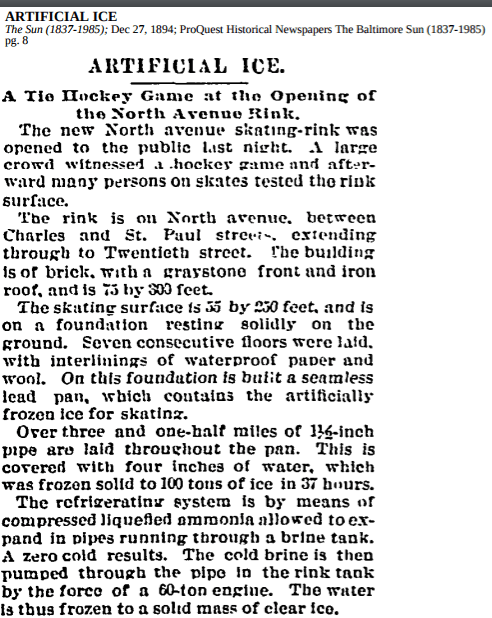
Regardless, the first game was played at the North Avenue Ice Palace in Baltimore, in a place which is now a vacant parking lot between Charles and St. Paul Streets in Baltimore. The rink itself was a marvel of then-modern technology being the first artificial ice surface in the US. The rink opened December 26th, 1894 with the playing surface being 250 feet long and only 55 feet wide. This was also in a day where there were seven players on the ice, including the goalie. Below is a brief detail of how it was all set-up.

Screenshot 2018-02-25 at 3.19.20 PM.png

During that time, while the pro game hadn’t hit that area as of yet, there were plenty of athletic clubs in the area who had teams that played regularly, almost what rec-league would be considered today– but with more skill. With areas like Washington, DC and New York getting into it during the early days, the sport grew very quickly in popularity. Baltimore-area stores for a time couldn’t keep equipment on the shelves due to the people wanting to try it out. Yet, with World War I happening, coupled with the depression– the sport lost it’s popularity in Baltimore, with the Johns Hopkins team shuttering down around 1898 due to a variety of issues with travel and the school support. The North Avenue Ice Palace closing down in 1932, despite not holding a hockey game since 1898 and then having the ice machinery taken out in 1899.

It wasn’t until Carlin’s Iceland was built in 1932 that Baltimore got another team they could take pride in, the Baltimore Orioles. The oriole name has been and still is held by a lot of Baltimore teams (mostly baseball) due to it being the state bird, as well as the bird having the wings that resemble Lord Baltimore’s Coat-of-Arms. The hockey Orioles were a member of the Tri-State League and the Eastern League, spanning a decade from 1932 until they closed up shop in 1942. Names like Vince Papike, Vern Buckles, Norm Calladine (when on to play with the Boston Bruins), and Fred Hunt were stars for these Orioles teams. The Orioles went on to win the 1939-40 Eastern League title, while also garnering a couple Mayor Cups, an in-season tournament between teams.

bs-1516400152-regldfpyvw-snap-image

The 1938 Baltimore Orioles hockey club/Photo from Baltimore Sun archives

The fans took to the Orioles, as well– many of them going too far at times. Many times, the police had to come in to break up the fights in the stands, which spilled onto the ice. Fans would also hurl objects onto the ice to calls and players they objected to, which caused the Baltimore players to love their fans, with the rest of the league despising them. Essentially– they were then what Philadelphia fans are today.

High school hockey also boomed during this time, with many of the local schools taking up the game and playing at Carlin’s. Only 3,000 seats were in the building, but with hockey and figure skating show being put on, the place was packed each and every time. However, the Orioles disbanded after the 1941-42 season due to World War II, while Carlin’s Iceland then housed the first incarnation of the Baltimore Clippers before it burned to the ground in 1952.

Marylander Giles Helping Non-Traditional Developmental Area Get Noticed

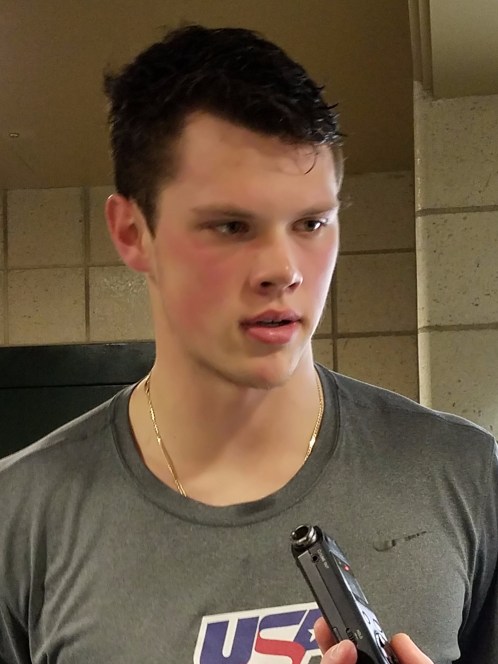
20171230_213509

Patrick Giles/Photo by @NHLHistorygirl

It may not come as a surprise to you (especially with my rantings on it), but Maryland isn’t the biggest hockey factory in the USA. In fact, some would think it’s one of the outliers despite the Washington Capitals being around in the area for over 40 years. The thing is that it hasn’t been until recently that there has been a surge of players who come out of Maryland that weren’t sons of Capitals players.

One of the players who are leading the charge for the younger ages Maryland players is Patrick Giles. Currently playing with the US National Team Development Program, Giles left Landon School after his sophomore year, which is very unheard of when it comes to Maryland players. Sam Anas, who also went to Landon, played all four seasons before moving on with Quinnipiac University and then to an NHL contract.

“Leaving Landon was hard, especially with all my friends there,” said Giles after the USNTDP game against North Dakota. “The coaching there was phenomenal for Maryland hockey. They definitely helped me with my development and get where I am today.”

Of course, for a 16-year-old to get up and leave high school is fairly hard, but when it’s going for your dream– it’s a risk you have to take. When given an opportunity like Giles was given, one would have to leap to a chance; though not without a lot of thought put into it.

“It was tough at first,” Giles remember,  “But, after I got the call that I made it, it was pretty easy because it’s such a big opportunity and I couldn’t turn it down. But it was definitely hard to leave my family.”

While there has been a number of players to play college from Maryland, especially in Division I recently, Giles is getting a bit of a head start with the U18 USNTDP program. The team does participate in a partial USHL schedule, as well as international tournaments, but the team does face-off in exhibitions against Division I and Division III schools to see how they fare and stack up. With many of those on the U18 team already committed to D1 schools, it’s a good test.

What’s great about this team is it gives us the experience to play against top colleges,” mentioned Giles– a Boston College commit. “It lets us ready for college and wherever else we may decide to play in in the future.”

While the team is made up of other college commits, it’s also full of draft eligible players. The likes of Auston Matthews, Jack Eichel, Seth Jones, and Rick DiPietro have been through the NTDP system and been top draft picks. However, Giles and his teammates don’t seem to be concerned with that saying that they really just focus on the next game. However, if he does get drafted– he’d be (by my count) the fourth Maryland-born player to be drafted into the NHL– Jeff Brubaker, Jeremy Duchesne, and Graham McPhee being the other three.

With Giles, along with Adam Varga in the OHL, paving the way for Maryland to perhaps become more visible on the prospect-front and have more kids not have to go outside the state in order to get noticed. Giles takes it to heart and takes pride in being from Maryland.

“Coming from Maryland, a couple of guys have gone the same route,” said Giles. “Just being from a non-traditional market like Maryland, it’s been great to have the support for my state and from my family. It’s been a great experience for me.”

On the Topic Of Marylanders in College, Junior, and Pro Hockey

If you have followed along in my life, Maryland is a huge part of it. After living in Glen Burnie for 21 years, obviously there’s a sort of pride there. But recently, I’ve seen an influx of Marylanders getting into the pro hockey ranks, as well as Division I NCAA and Major Juniors. With it being a dormant landscape for hockey, it’s always a fine sight to see a kid from Maryland get noticed on a big stage.

236-nick-ellis

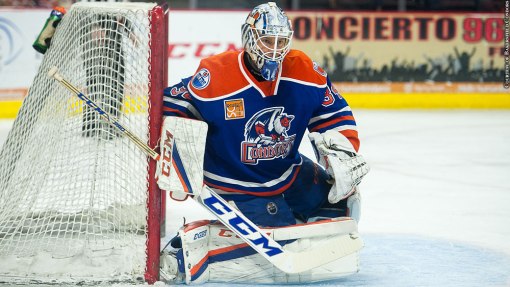
One of the bigger ones recently has been Nick Ellis of the Bakersfield Condors. The Millersville native was signed by the Edmonton Oilers as a free agent after three years at Providence College where he posted a 30-9-5 record with a 1.90 GAA. Earlier this year, Ellis got AHL Player of the Week honors and has been put into a bigger role for the Edmonton affiliate.

Another player to possible get buzz this year or next is 16-year-old Adam Varga. After playing for the Washington Little Capitals U15 team, Varga took an unorthodox step by jumping to Major Juniors and signing with the Mississauga Steelheads of the OHL. While there are territorial disputes of who’s a Marylander and who’s not (more on that in a second), but my count he is the fifth Maryland-born player to play in Major Junior after Jeff Brubaker (Hagerstown), Jeremy Duchense (Silver Spring), Charlie Pens (Perryville), and Campbell Elynuik (Silver Spring) to be stated as Marylanders in Major Junior. It’s a big step for hockey in Maryland and how the development is, as most Maryland kids go the NCAA route or even the Division III route for their higher-level hockey.

However, there is a bit of a conflict when dealing with player bios because some players will put somewhere else outside of Maryland, while other sites will post Maryland as their hometown. Elynuik is a perfect example as he is listed on HockeyDB as being from Silver Spring, but Elite Prospects will have him listed as being from Calgary, Alberta. Jarred Tinordi is another example, as he was born in Burnsville, Minnesota; but made his hay in Severna Park, Maryland– playing for Severna Park High School in his first year before going to join the US National Developmental Team. A guy like Michigan State’s Jared Rosburg is a whole other can of worms. Rosburg is listed as being from Clarksville, Maryland, but grew up in Strongsville, Ohio. Since he played for River Hill in Howard County, I’ll chalk Rosburg up to one of Maryland’s own.

(Elynuik, Tinordi, and Duchense bring about another example of guys listed as being from Maryland thanks to their father’s playing with the Washington Capitals when they were born. While Tinordi did play within the area, the others didn’t make that big an impact, especially with Duchense living in Quebec City for the majority of his youth.)

10.2.16_MSUHK

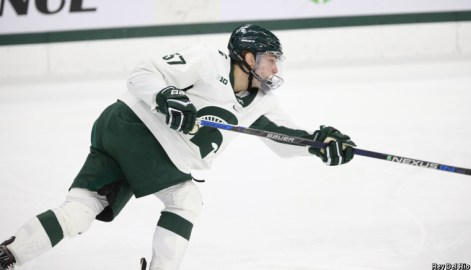
Rosburg is one of many players who have touched NCAA Division I ice while being listed as a Marylander. The Michigan State defenseman has dealt with injuries, but has been a big presence on the blue-line and has come up with some big goals in his short career. Rosburg is following in the footsteps of Sam Anas, who is recently the most successful Maryland player, as he’s been in the Minnesota Wild organization for two years after a successful NCAA career at Quinnipiac after a solid high school career at the Landon School in Bethesda. Of course, Anas goes in that disputed Maryland/Washington DC zone where both sides want to claim him. Colgate’s Bruce Racine is in the disputed zone of Maryland/DC, as he was born in DC, but went to school in Bethesda at Georgetown Prep. Other NCAA players for the 2017-18 season are Matt McArdle (Annapolis/Lake Superior State), Colin O’Neill (Odenton/UMass-Lowell), Jason O’Neill (Odenton/Providence), and Graham McPhee (Bethesda/Boston College).

In the minor leagues, outside of Ellis and Anas; there are several others playing in the lower minor league ranks. Jack Burton was born in Reisterstown and went to Baltimore-area St. Paul’s school before heading to Colby College and then joining the Indy Fuel last season, where he is today. Another Maryland ECHLer is Nick Sorkin of the Wheeling Nailers, who played for Team Maryland and the Washington Little Caps before going to University of New Hampshire, then to the Nailers. Former Glenelg High School player and Woodbine native Eric Sweetman is in the ECHL, as well, playing in Idaho after four years at St. Lawrence University. Mike Chen played for Team Maryland growing up before heading to Division III at Salem State and is currently rostered on the Knoxville Ice Bears of the SPHL.

Women’s hockey has also grown in Maryland, especially with the likes of Haley Skarupa being from Rockville and playing on the US Women’s National team, as well as in the NWHL with the Connecticut Whale and Boston Pride after four successful seasons at Boston College. Beth Hanrahan of Poolesville played four years at Providence College for four years, being the team’s MVP in her junior and senior season, then playing for the New York Riveters before being name associate coach of Lindenwood University. Finally, Lindsay Berman of Odenton starts her third season as head coach of UMass-Boston’s Women’s team after her years in the CWHL with the Boston Blades, including a Clarkson Cup championship to her resume. Berman went to Arundel High School and played for the Washington Pride to garner attention leading her career at Northeastern University.

I’ve said before about how Maryland and the mid-Atlantic has been underserved as a market, especially with no NCAA program in the state. However, there’s a new wave coming through, especially with Varga in the OHL and young Patrick Giles (Chevy Chase) joining the US National Program; there’s a lot of shoot for in the youth programs in the Maryland (and sure, DC) area, though the high school systems does have a variety of teams. Also, the club hockey scene does have a lot of talent, but still not the top-tier talent other areas have. The area is still in need of more success stories, but I know I didn’t think in a million years there would be this much Maryland content across the NCAA and minor pro landscape as there is today.