McKenna’s Fanatics Card Deal Brings Intrigue and Future Questions

Gavin McKenna has all the hype in the world surrounding him as the college hockey season starts. The Penn State University forward and projected #1 overall pick in the 2026 Draft  is the talk of the college hockey world after his two giant seasons in the WHL putting up 79 goals and 244 points in 133 games. 
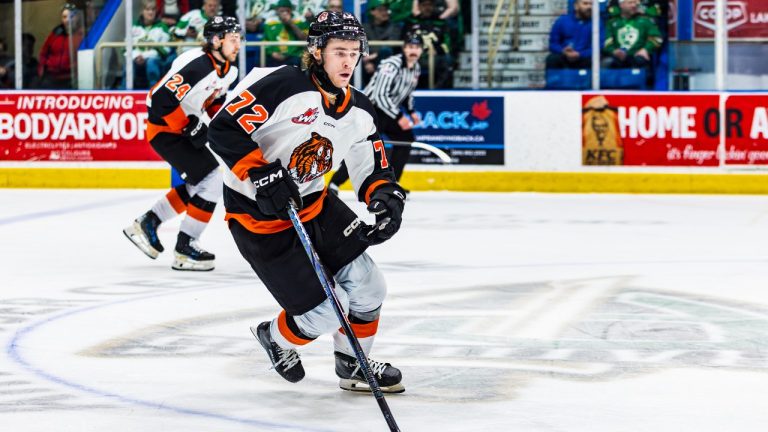
Today, it was announced that Fanatics and Topps had signed McKenna to a trading card and autograph contract. Topps and their Bowman U set will be at the forefront for McKenna swag, with cards featuring McKenna throughout his year and marking any milestones along the way. Some cards will also include game-worn relics and have his autograph on it. 

After looking at the email from the PR company who, I assumed, helped broker the deal– I decided to ask some follow-up questions; mainly how long this contract is for. That would be important should McKenna be a one-and-done player at Penn State and move to the NHL– who has Upper Deck as their exclusive card maker. The Young Guns rookie cards in the Upper Deck flagship collection is a big hunt for collectors. Not only that, but Upper Deck has other brands that deal with relic cards and autograph cards in their higher end sets. 

If the Fanatics contract is a long-term, that throws some questions about McKenna’s inclusion into the Upper Deck sets and what can and can’t be used from him once he reaches that point. 

The PR group did not have an immediate answer for that question. 

Nor did the group have an immediate answer to when the roll-out dates for any of McKenna’s cards would happen, what role Topps Now could play into this contract, and if this would be a jumping off point for other college players of notable stature. 

Therefore, we’re in a holding pattern to see what will come out, when it will come out, and how much the market will crave it. Also, we’ll have to wait with bated breath about what it could mean in his jump to the NHL and their deal with Upper Deck and how that would play out, as it would have a big implication on the hobby side of things. Hell, we could maybe even see if the NHL will do what the NFL and MLB have done and jump to Fanatics for their trading cards, leaving Upper Deck like the other leagues left Panini and Upper Deck for the Topps brand exclusively (not without legal things happening in Panini’s case). Honestly, I’m shocked it hasn’t happened yet considering Fanatics does the jerseys and online marketplace for the league. 

In any case, it’s an exciting time for McKenna to have himself another solid deal before he starts his college career and it’s an interesting one for collectors to see what the market value will be and how it’ll fluctuate over time. Not to mention the future of where this goes for the hockey hobby. 

Tip of the Cap to Minot State

Photo via Minot State Athletics

What the Minot State Beavers did this weekend was subjectively pretty damn cool, as they took on Colorado College and University of Denver this past weekend in two exhibition match-ups. Minot State is currently the #1 team in D1 ACHA (non-varsity) hockey; while Colorado College is #20 and Denver is #5 in D1 NCAA (varsity) hockey. Minot State dropped both games– 7-1 to Colorado College and 9-3 to Denver– but for them to go out there and see how they stacked up against the top teams in the nation on the NCAA side is a good litmus test for them.

Denver is no stranger to ACHA teams, as this was their third straight year playing against a team in an exhibition. Denver beat UNLV last year 10-0 and Lindenwood, a year before they made the jump to NCAA, 9-1 to start their 2021-22 campaign. This was Colorado College’s first time against an ACHA team. This season alone, Arizona State took on Arizona and Ferris State took on Grand Valley State, with Arizona State (16-0) and Ferris State (9-0) defeating their ACHA counterparts. 

Arizona State is well-versed in ACHA hockey, as they are one of the three teams recently who made the jump from ACHA to NCAA. Penn State and Lindenwood were the others who have gotten school support to move up to a varsity sport since 2012. 

Non-varsity hockey is college hockey in its fullest form, but there’s also the obvious gaps that remain when it comes to NCAA and ACHA schools. Mainly, the money and support of the school are the main factors and the cause of the effect that they can’t get the top ranked players the NCAA schools can get with scholarships and such. 

That’s not to say the talent, passion, or intensity isn’t there. There are plenty of skilled players in the ACHA ranks, they just went to a school that didn’t have varsity hockey. They can still be found throughout the ranks of the ACHA, but because they aren’t getting full school support; they won’t get the pick of the litter that NCAA schools have. For the passion and intensity, the ACHA players may have more than their NCAA counterpart as they may not have a competitive hockey career after their college days are done, so they are playing to the fullest every game they are out there. Not to mention the fan bases are as intense at some schools as they are in the NCAA with how vocal and supportive they are of their squads. 

The ACHA casts a further net for college hockey than the NCAA with 72 teams having Division 1 status in the ACHA to the NCAA’s 64. Not only that, but the ACHA has teams spanning to the Western US, Mid-Atlantic, and Southern US more than the NCAA has done; though the NCAA has been trying hard to expand their footprint to those areas. On the lower end side, the ACHA has almost 200 teams in Division 2 and close to 150 in Division 3. On the women’s side, they are lacking a little with only 31 in Division 1 to the NCAA’s 43. There are also 67 Division 2 women’s programs in the ACHA. 

At the end of the day, maybe the results of these games for Minot State were obvious to some. While notching four goals in two games while giving up 16 doesn’t seem that great, it has been more than other ACHA teams have gotten against NCAA squads in the past three years. It was a big step for non-varsity hockey and maybe it will get some people to look local to see what schools around them have a team and maybe get out to support college hockey to the teams and players who need the support just a little bit more than varsity teams they go up against. 

UND HOCKEY: Fighting Hawks Complete Sweep of Denver in First NCHC Weekend

GRAND FORKS, ND– Following up on Friday’s victory, the University of North Dakota Fighting Hawks were able to give an encore performance of their all-around performance with a 4-1 victory over Denver Saturday night, sweeping the first weekend of conference play. Things, however, took a turn late in the game, as the rivalry boiled over on many fronts.

North Dakota got off to a quick start with plenty of offense from the start. The persistence paid off as 4:59 in, Ashton Calder’s pressure on the Denver point created a turnover, which lead to Matteo Costantini breaking away from the pack and putting home his third of the year past Magnus Chrona to make it 1-0 UND. The pressure continued, as the zone time for UND was big in the first frame, leading to 12 shot on goal in the first period. Just after the midway mark, Judd Caulfield spun out of the corner and drove to the net, creating a rebound for Tyler Kleven to make it 2-0. It was the first of three four-on-four goals for the Hawks on the evening.

The second period had Denver coming back a little more, putting pressure on Zach Driscoll a little more, but Driscoll was equal to most task. The only hiccup on the record was an attack 6:24 into the second, when Ryan Barrow was the recipent of a great passing play between himself, Jack Devine, and Brett Stapley to cut the UND lead in half after Barrow put it over the glove of Driscoll. The Hawks didn’t pressure Chrona as much as they did in the first, but the chances they did have were quality and created by an aggressive forecheck on the Denver defense.

Four-on-four play struck again for North Dakota, as Riese Gaber took a Jake Sanderson breakout pass the length of the ice, making a power move cutting in from the far boards, and tucked it under Chrona for the 3-1 marker. North Dakota kept the pressure on, hitting a few posts behind Chrona but not finding the back of the net. The transition and pressure of North Dakota halted many chances for Denver to get back into the game.

Things then took a turn, as with the Denver net empty, Mark Senden looked to seal the game, but Carter Savoie came across the ice, leapt towards Senden who was trying to gather the puck up, and Savoie’s forearm hit Senden in the head, knocking the UND captain to the heap on the ice and creating a stir after the fact. Senden went off with assistance from the trainer and Savoie got a five and game for his troubles. Things continued to get feisty, as Tyler Kleven’s big hit upon Denver’s zone entry was a bit too high for the liking of the officials and he got a five and game, as well.

At the end, Calder got the open net goal and UND secured the sweep of the weekend. It puts the Hawks at 2-0-0 in NCHC play as they head to Miami next weekend.

THEY SAID IT

“This was a character-builder and for sure a team-builder for our team for the year, the way they battled up. I think that was learning lesson last night, kind of sit back in the third period with a one-goal lead. We said you know what, we’re not sitting back, playing not to lose, we’re playing to win.”– Head coach Brad Berry on his team’s performance Saturday.

“That was huge for us confidence-wise. I think not a lot of people expected that. I know we have a lot of belief within our team here. We definitely showed that tonight.”– Riese Gaber on the meaning of this sweep.

Ottawa, North Dakota, and Going Pro

The Ottawa Senators seemingly trust the process that the University of North Dakota has with prospects. They’ve selected three in the NHL Draft that were committed to the school in the past two drafts– Jacob Bernard-Docker, Jonny Tychonick, and Shane Pinto. The question is now will they let those players see the process develop for more than half their term there.

A report out of the area had said the Senators were pushing hard to help the OHL’s Ottawa 67s gain the rights to Pinto in order to sign him to an entry-level deal; thus taking the freshman forward out of the UND pipeline. This comes after Pinto had an impressive World Junior tournament with four goals and seven points in five games for the US squad. After Saturday’s game, however, Pinto vehemently denied anything of the sort ever happening; proving the Ottawa media wants to get people to hope that he’d come to speed up the rebuild process.

While there hasn’t been a lot of noise made about Bernard-Docker, you’d have to think that Ottawa would want him to leave school after this season, considering his low-key breakout at the same World Juniors, playing more than any other Canadian during the tournament. Though, there might be a double-standard with bringing a defenseman out early and how much it takes for them to truly adjust to the professional game.

Ottawa is a rebuilding team and while they may like the way that UND is able to produce NHL, they probably also want to really get the players as their blossoming in their career. The Pinto situation seems familiar to the Tyson Jost/Avalanche situation, with Jost leaving after his freshman season at UND, with many saying Colorado was pretty adamant about Jost leaving after one college season. Though, Brock Boeser left after two seasons and did pretty good for himself by doing so, even though injuries have hampered both Jost and Boeser.

I’m all for these players going for the money if they feel it’ll be the most lucrative for them in the long-run. The goal for them is pro hockey and if they can reach it sooner and if the team wants them sooner– more power to them. The only hurdle is to make sure that they are, in fact, ready to make that jump. There’s cases for leaving too early and leaving too late, so it’s really a case-by-case basis.

North Dakota also doesn’t want to be looked at as a one-and-done kind of school and probably while it’s nice for them to have that aura of being a great developmental point for possible NHLers, it’s not the way they would want to be viewed overall if they only have talented youngsters for one or two years before they go off elsewhere and then UND gets behind because a player they thought they could build around for four years is only there half that time.

Sure, it’s the nature of college hockey and could happen with players who aren’t drafted, also; but in those cases– you’re getting three seasons from them and could actually have their replacement ready to go and a plan in place for it. In the day in age where the NHL is a younger players’ game with speed and skill, the college kids will definitely have a harder time wanting to stay if the idea of making a good amount of money without the schooling aspect is at their fingertips.

At the end of the day, each drafted college player is a case-by-case study of what they’re going to do. Some stick the whole four years, some leave after one, and some don’t make it to one year before moving to major junior; you can never know what could happen with each player.

Wright, Savoie, and Exceptional Status

In Canadian major junior hockey, the exceptional status is given to a 15-year-old player who the league deems good enough to play an entire season at the major junior level. Otherwise, the player would only be able to play five games at age 15 in major junior until they turned 16. Before this season, the only players who were granted exceptional status in the Canadian Hockey League were Connor McDavid, John Tavares, Aaron Ekblad, Sean Day, and Joe Veleno. Of all of them, only Veleno wasn’t playing in the Ontario Hockey League; he was a Quebec League player.

This season, two players applied and only one was granted the status. Shockingly enough, it was a player from the OHL that was given the status in Shane Wright. The other– Matthew Savoie– was not given status, despite him having been compared to Sidney Crosby at age 14. It also continues the Western Hockey League not granting players exceptional status. Due to this, Savoie said that he committed to the University of Denver for the 2021-22 season. It should be noted that Jack Hughes also applied for exceptional status two years ago, but was denied and is now on his way to University of Michigan next fall….maybe…if he doesn’t get to the NHL before that, as he is projected to be one of the top two picks in this Draft.

There’s two way to think about this whole situation. The first is that it’s a travesty that the WHL isn’t letting this kid, who has 31 goals and 71 points in 31 games playing a year older than he should be. The second is that it’s good that the WHL isn’t rushing a kid who may not be able to deal with the grind of travel and physicality that the WHL often presents, not to mention the mental and maturity factor of it all.

It’s easy to see both sides of the coin. You don’t want to have a kid who’s obviously head and shoulders above his peers in bantam or midget hockey, risk him getting bored or even seriously injured, or embarrass the competition. In most of the exceptional cases– the players were able to succeed with three of the five of them being 1st overall picks in the NHL Draft and four of five being in the first round. Sean Day was the player who didn’t get pick in the first round, though he was also the only defenseman of the group who was given that status.

Some believe that Day’s performance was the reason why Hughes wasn’t given the status, but that’s subjective as hell and you could counter that by saying it takes defensemen longer to develop than forwards.

On the flip side, it’s almost good for the younger players not getting bigger than they should be if they aren’t ready for it. Again another subjective aspect of the judging process, but at the same time– to hold off on a player who the committee may have the slightest doubt of it is erring on the side of caution. You may lose a player or two– like with Savoie and Hughes– but it might be better than burning them out at a young age or having them flame out when such high expectations were placed onto them. Plus, when I mentioned maturity– these kids at 15 may or may not be ready to take on a pro-like schedule, away from home all the time, and growing up before they may be ready to.

While it could be the CHL’s loss, the NCAA does have the ability in something great. Of course, Hughes may not make it to the college level, while Savoie could be using his as a bluff or doing the same thing as Jack Eichel in playing the year before his draft year and then leaving after a season. Many claim that the major junior route is the quickest route to the NHL– and it’s probably true– but at the same time, if Savoie and Hughes can play in the NCAA, even for a year, and dominate before going to the NHL; it may change some opinions…but probably not.

UND HOCKEY: Fighting Hawks Need Extra Time to Topple Tigers

GRAND FORKS, ND– After a weekend that saw them throw everything and the kitchen sink against their opponent, but still only able to muster two goals in the weekend; the University of North Dakota Fighting Hawks needed to rebound quick, as NCHC play started back up in full force. This weekend, they welcomed the Colorado College Tigers into The Ralph and used almost every minute of regulation and overtime to get a 4-3 win on the first game of the weekend.

It took until halfway through the first for UND to solve Alex Leclerc and it took a power play to do so. After the two-man advantage was killed, Nick Jones got the puck down low from Jacob Bernard-Docker and somehow was able to find space where there didn’t seem to be any over the shoulder of Leclerc to make it 1-0 for the Hawks. While UND did have a shot advantage in the first of 11-7, they seemed to have better quality chances against Leclerc than Colorado College had against Adam Scheel.

After plenty of sustained pressure in the zone, Andrew Peski’s shot from the point went off of Colorado’s Zach Berzolla and past Leclerc to make it 2-0 for the Hawks. Colorado College cut the lead in half after a power play goal by Westin Michaud– who drew the penalty– as his shot trickled past Scheel despite the UND goalie getting a glove on it– but couldn’t stop the momentum afterwards.

Under three minutes into the third, Colorado College tied it up after Erik Middendorf picked up the puck off a blocked shot and put it past a scrambling Scheel. Off the goal, Gabe Bast leveled Colorado’s Alex Berardinelli, which resulted in Berardinelli needing help off the ice, as Bast got a five-minute major and ten-minute misconduct for targeting the head. Less than thirty seconds into the power play, former North Dakota forward Chris Wilkie put home his fourth of the season with a wicked shot from the top of the circle and put the Tigers up for the first time in the game, though it was the only goal on the extended power play. With almost five minutes to play, UND got back on the board, as Jordan Kawaguchi tipped home a Nick Jones slap-pass/skate tip shot to knot the game at three, which led to overtime.

Jordan Kawaguchi/Photo by Jen Conway

“I didn’t see anyhing,” said Kawaguchi post-game. “I just went to the net with my stick on the ice. I don’t know if Nick’s shot would have gotten in or not, but just going to the net with my stick on the ice. It’s something coach has been talking about, getting into the dirty areas and goals will come.”

Just when it looked like it would go to a shootout to see who got the extra NCHC point, Ludvig Hoff tipped a Jacob Bernard-Docker point shot over Leclerc’s shoulder to give UND the overtime win by a score of 4-3.

“It was huge for a lot of reasons,” remarked head coach Brad Berry. “First of all, get back in the win column. Second climbing the standings in the NCHC, Pairwise is a big thing. But the morale of the group here. You’re working hard all year and in the end, sometimes you don’t get rewarded. We got rewarded tonight.”

UND is hoping that the rewards continue and try to finish the weekend with four points on Saturday night.

UND HOCKEY: Statement Game for UND in Big Game One Victory

DX57sydXcAUZvU5

Photo via @UNDmHockey

GRAND FORKS, ND– With their tournament hopes on the line with this single series, the University of North Dakota and University of Nebraska-Omaha took to the ice in the first of a best-of-three NCHC Quarterfinal match-up on Friday night. With each team splitting the regular season series at two wins apiece, each side knew they were in for a tough series for a chance to make it to the Frozen Faceoff in St. Paul next weekend, as well as having a better chance of getting into the NCAA Tournament. Knowing they needed a solid showing, UND came through in a big way in front of 10,125 at the Ralph Engelstad Arena, taking Game One 4-0 over Omaha.

After a steady first 14 minutes, UND broke the ice as Shane Gersich rifled a wrist shot home from the the top of the circle and thanks to a screen by Colton Poolman, was able to get past Omaha’s Evan Weninger to make it 1-0 Fighting Hawks. A very quiet frame before and after with shots registering in at 11 for UND to Omaha’s six.

With 1:54 left in a carry-over power play, UND made the most of it with many great chances, but Christian Wolanin’s wrister hit the back-bar past Weninger to make it 2-0 for UND. The pace of play stayed consistent with not many good chances either way, but Nick Jones changed that with 7:21 left in the second. Coming off the bench to a loose puck, Jones went wide, then made a little flip of the puck over the Omaha’s defender’s stick and took a diving shot that went past Weninger to make it 3-0. Four minutes later, Omaha’s Joel Messner fumbled a breakout attempt, in which Joel Janatuinen made no mistake to bury it past Weninger to make it 4-0.

20180309_222114

Christian Wolanin/Photo by @NHLHistorygirl

“Our forwards were working so hard on the forecheck, maintaining pressure and making it hard on their defense,” said Christian Wolanin. “Our defenseman did a good job moving it north quickly. All the little things made up for some big goals for us.”

One big chance in the third saw Weninger make his best save of the night with a big cross-crease glove save on Grant Mismash to deny UND a fifth goal. UND outshot Omaha 34-25 in the game. It was Cam Johnson’s third shutout of the season and 12th all-time at UND.

“The key for us was to make them play defense,” mentioned Wolanin of UND’s ability to shut down Omaha’s threats. “If we don’t give them the puck and eliminate time and space, we’re going to have success against them.”

“It’s a good start. That’s the key word: start,” North Dakota coach Brad Berry said. “It’s just one game. I thought our guys did a lot of good things. The biggest thing is focusing on tomorrow. Tomorrow is another day and our lives are on the line still. There’s going to be a business-like mentality there.”

With the win, UND moved to 14th in the Pairwise Rankings, which is heavily used in helping determine the at-large bids for the tournaments. With that win, they move ahead of Omaha and would give themselves a better chance of moving up if they can sweep the series on Saturday.

“You kind of hear about what people are saying, but we’re focused on tomorrow,” defenseman Colton Poolman said of the Pairwise. “All that stuff is in the rear-view for us. We’re just focused on tomorrow.”

Puck drop is 7:07 at The Ralph, as UND looks to move onto the Frozen Faceoff next weekend and then to the National Tournament.

Maryland Hockey History Week: First College Game, First Artificial Ice, First Pro Team

Johns_Hopkins_University_hockey_team,_1895–96.jpg

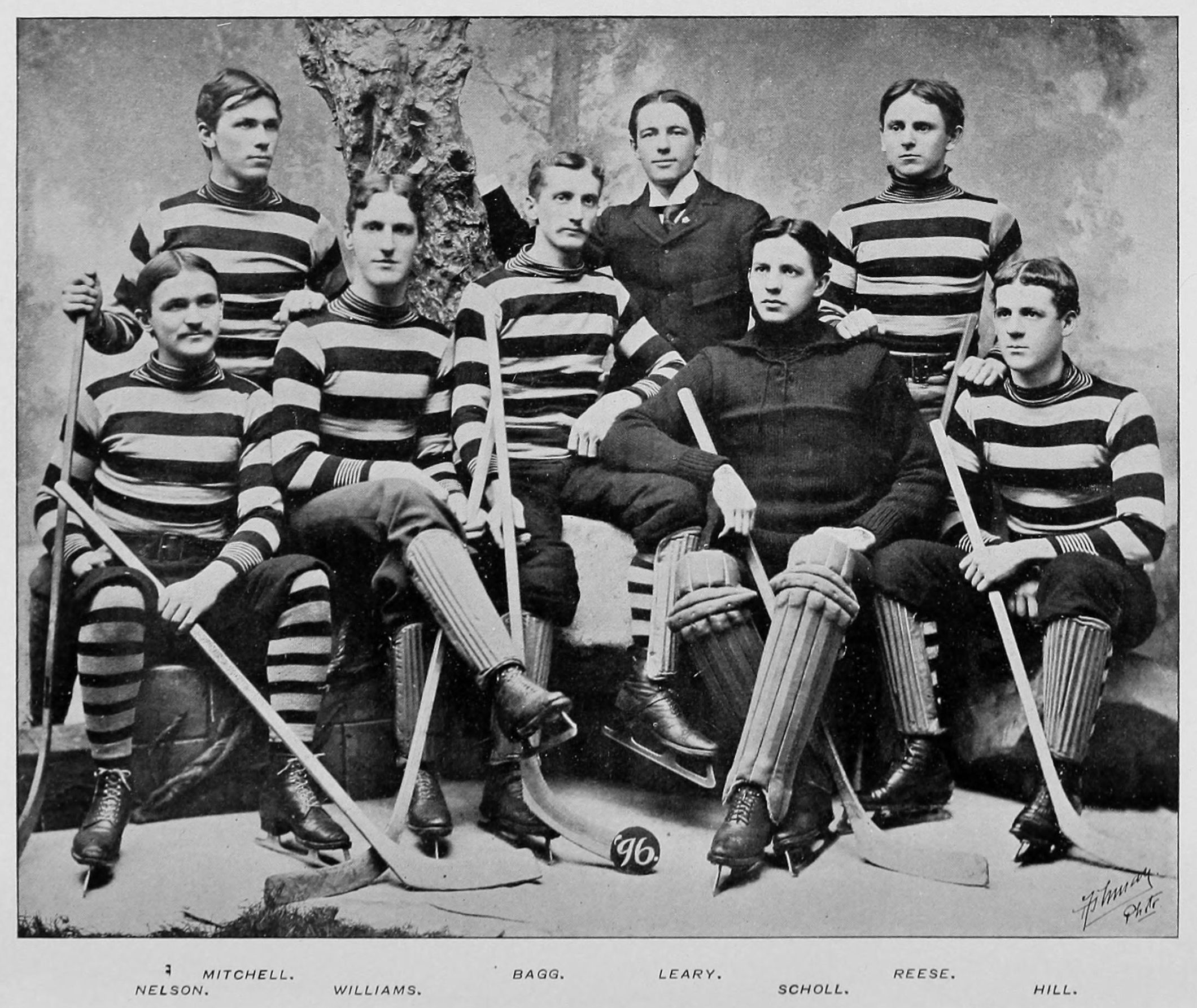
Johns Hopkins University hockey team, 1896/ Photo from Johns Hopkins University Sheridan Libraries

Few will believe that the first college hockey game happened in Maryland. Even more will cock an eyebrow when they’re told that Johns Hopkins University was involved in the first college game, especially since they’ve never had anything higher than a club team in ice hockey. Yet, on that fateful February 1st in 1896, Johns Hopkins played Yale University to a 2-2 draw. It should be noted that Yale disputes this, saying that the first game was February 14th and they beat Hopkins thanks to Malcolm Chase’s two goals– but what do you expect from those Yaleies?? Below, as you can see, was printed on February 3rd, 1896.

Screenshot 2018-02-25 at 2.46.46 PM

Screenshot 2018-02-24 at 9.04.54 PM

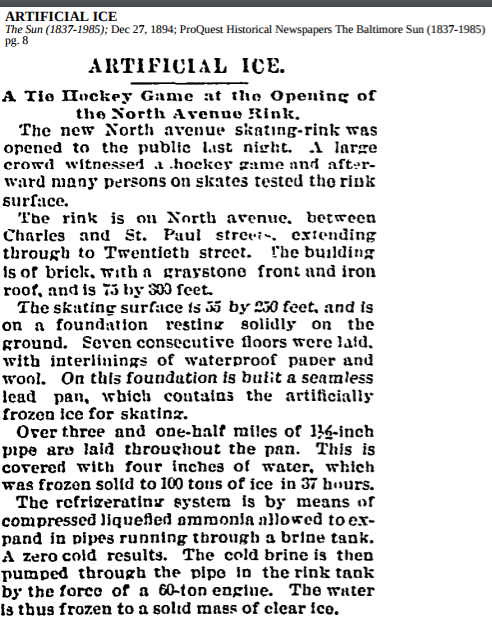
Regardless, the first game was played at the North Avenue Ice Palace in Baltimore, in a place which is now a vacant parking lot between Charles and St. Paul Streets in Baltimore. The rink itself was a marvel of then-modern technology being the first artificial ice surface in the US. The rink opened December 26th, 1894 with the playing surface being 250 feet long and only 55 feet wide. This was also in a day where there were seven players on the ice, including the goalie. Below is a brief detail of how it was all set-up.

Screenshot 2018-02-25 at 3.19.20 PM.png

During that time, while the pro game hadn’t hit that area as of yet, there were plenty of athletic clubs in the area who had teams that played regularly, almost what rec-league would be considered today– but with more skill. With areas like Washington, DC and New York getting into it during the early days, the sport grew very quickly in popularity. Baltimore-area stores for a time couldn’t keep equipment on the shelves due to the people wanting to try it out. Yet, with World War I happening, coupled with the depression– the sport lost it’s popularity in Baltimore, with the Johns Hopkins team shuttering down around 1898 due to a variety of issues with travel and the school support. The North Avenue Ice Palace closing down in 1932, despite not holding a hockey game since 1898 and then having the ice machinery taken out in 1899.

It wasn’t until Carlin’s Iceland was built in 1932 that Baltimore got another team they could take pride in, the Baltimore Orioles. The oriole name has been and still is held by a lot of Baltimore teams (mostly baseball) due to it being the state bird, as well as the bird having the wings that resemble Lord Baltimore’s Coat-of-Arms. The hockey Orioles were a member of the Tri-State League and the Eastern League, spanning a decade from 1932 until they closed up shop in 1942. Names like Vince Papike, Vern Buckles, Norm Calladine (when on to play with the Boston Bruins), and Fred Hunt were stars for these Orioles teams. The Orioles went on to win the 1939-40 Eastern League title, while also garnering a couple Mayor Cups, an in-season tournament between teams.

bs-1516400152-regldfpyvw-snap-image

The 1938 Baltimore Orioles hockey club/Photo from Baltimore Sun archives

The fans took to the Orioles, as well– many of them going too far at times. Many times, the police had to come in to break up the fights in the stands, which spilled onto the ice. Fans would also hurl objects onto the ice to calls and players they objected to, which caused the Baltimore players to love their fans, with the rest of the league despising them. Essentially– they were then what Philadelphia fans are today.

High school hockey also boomed during this time, with many of the local schools taking up the game and playing at Carlin’s. Only 3,000 seats were in the building, but with hockey and figure skating show being put on, the place was packed each and every time. However, the Orioles disbanded after the 1941-42 season due to World War II, while Carlin’s Iceland then housed the first incarnation of the Baltimore Clippers before it burned to the ground in 1952.

PSA: Maryland Jerseys On Sale Now

DSFkMCOUIAA_7ar.jpg

While this isn’t a paid product placement at all, I’ve got to let everyone know that the University of Maryland club hockey team is releasing their jerseys for sale for the month of January.

A link to their Google Form for the jersey is here and you should definitely look into getting one because they are slick as hell. At the price point of $120 plus $10 shipping, it’s a pretty decent deal to say the least.

More over, it’s to help the team out. Which they are trying to get the pride of Maryland out to the masses, it also is helping pay the teams bills. The club hockey team has to pay a lot of things out of pocket– especially for ice time and uniforms. The team set up a Go Fund Me earlier in the year to help with the costs of new white jerseys after the school ditch the script that the team had on the front of their whites. I’m assuming to stay in the good graces of the school and to get some kind of funding, the team had to change it. Rather than go out of pocket, the Go Fund Me got to about 75-80% of the goal when all was said and done, which help off-set a huge cost to the players.

At the semester break, the Terps are ranked #9 in the ACHA Southeast Division II standings with a 13-6-1 record. The team is currently on a three-game winning streak, while also winning nine of their last ten games heading into the break. In those nine wins, the Terps have outscored their opponents 53-19. The Terps will return to the ice January 19th at their home rink of the Laurel Ice Gardens to take on Rowan University.

So, get yourself a new jersey for your collection, support college club hockey, and show up to random pro games with an amazing jersey on your back. It’s a win-win-win in my book.

Fixing the Minor League System

maxresdefault

Photo taken from N2B Goal Horns’ YouTube (https://www.youtube.com/watch?v=-BCELxhOAFw)

Yesterday, I talked about the Draft system in the NHL and how it is a broken system when it comes to the player’s rights and actual development with the team overall. However, the only real way to fix this system is to totally overhaul the minor league system as we see it today.

The idea to have a 31-31-31 system is a great idea for hockey– but are there 93 markets out there that are strong enough to keep things solidified for a decent amount of time and are there enough prospects out there to fill that team and make the pipeline system viable and valuable overall to the landscape?? You can say that there are a good amount of markets that are stable as hell, but you can’t assume that all 93 markets will be very strong if they stay across three leagues.

First, you have to make the minors mean something– especially if you change it to a point where players have to choose between their amateur status (in a world with Major Juniors is considered amateur and you have to leave there to start a pro career) and their pro career starting. You’d need a strong first step. Elements need to be taken from the SPHL– not saying that they’d be a jumping off point, but their regional presence is something that minor leagues need more of.

Second, take that regionalism and then create leagues that way. The problem with minor league hockey in the late-90s/early-00s is the fact that while there were a wide array of hockey leagues– they were all in competition with each other trying to be the Alpha League. The ECHL was in competition with the WCHL, UHL, CHL– but ultimately the ECHL won out. The AHL had to compete against the IHL, but the IHL’s owners were too enamored with competing with the NHL that they lost the plot and then the AHL won out.  The thing in this day in age– especially with a stress being put on development– is to take a page out of baseball and have multiple minor leagues in different regions, but a uniform classification for them to battle it out playoffs wise; almost like the NCAA and their conferences.

(In this scenario, amateurs are in my consideration Major Junior and NCAA, with the same rules applying that if you declare and sign a pro contract, you can’t go back to those teams– as a point I suggested with the post on Thursday. You can bet that the CHL will have plenty of push-back on that because they’re trying to run a youth-pro league off these kids; but it’s my imaginary situation– so get over reality for a bit.)

As great as the SPHL has been– they almost have to be considered independent to this whole scenario I’m putting together since I don’t believe there’s any official affiliation with the NHL and the SPHL clubs. Not only that, but I doubt there’s enough prospects for each team to sustain quality hockey across 31 Single-A teams. The SPHL is better off as its own entity anyway because they wouldn’t be held to the hard and fast rules of the NHL in their trickle down theory.

Therefore, the current ECHL is the entry-level point for players who declare and sign their pro contract. However, you can’t have the ECHL as one league anymore– you almost have to have the two conferences as two leagues under the AA banner of hockey. Hell, if they really wanted to get into it– make it three leagues under the banner and then the top teams meet in a final eight– the two top teams from each of the three leagues and overall wild card to win the AA title.

When it comes to the AHL– or AAA level– you can do what baseball does since teams are moving more westward with their teams. Especially with Loveland, Colorado coming into play next season, it just adds to that flavor. Again, you could have three leagues with an Eastern, Midwest, and Pacific leagues under that AAA banner to have all three meet akin to what I suggested with the AA league.

While minor league hockey does have its niche, the fact that people believe that one league is needed seems a little stupid, especially with how the NHL made sure to move their teams closer to them and then held the AHL hostage to make their games/travel less than the rest of the league or they threatened they would start their own league. In all honesty, they should have started their own league and started this upheaval quicker than what I’m suggesting.

Granted, some teams in some areas may want promotions, but at the same time– it’s knowing their market and knowing what they can be capable of doing in those markets with that league. An idea of relegation or promotion– which is sexy in a gimmick sense– won’t do much for stability in a cutthroat business of sports. It’s a nice idea, but when put into reality does more harm than good.

There’s a lot to enjoy about minor league hockey– but when you look at a successful and sustainable league, the regionalism of the SPHL is the front-runner for solid business model. They know their communities, they know their role in hockey, and they don’t get too ahead of themselves thinking they’re going to be the next big thing. They play to what they know and it pays off for them overall. If all minor leagues and minor league teams could see that and realize that regional hockey is a solid money maker/travel saver– then the divided leagues under the same classification could work out very well in order to save minor league hockey decades down the road.