That 2025 NHL Draft First Round Was…Something

The NHL has already black-listed our podcast, so let’s talk about how horrible the first round of the 2025 NHL Draft has been. It’s the first (and probably only) intentionally de-centralized Draft where the teams and their representation were not on-site for the Draft in Los Angeles. ESPN had the coverage for it and it was a sight to behold. Here’s some of my takeaways:
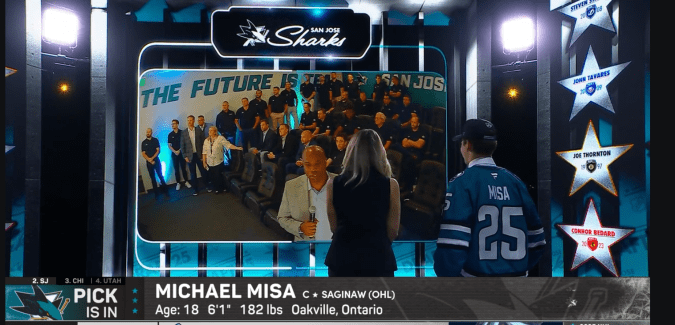
Awkward Post-Picked Interview in the Draft House

-Matthew Schaefer deserved better than ESPN constantly bringing up his mother’s death. While he is very open about it, for ESPN to bring it up like that and to focus on that when he was walking up, as he opened up with emotion, and as he was sitting there with Leah Hextall and her asking about it is way too much. He is such a strong person off-the-ice for what he had to deal with at such a young age…it’s not that hard to focus on his play that got him there rather than the tragedy he had to endure. 

-The guest pickers had some interesting choices among them. Shea Weber using an old flip phone to record the Predators choice, Adam Sandler as Happy Gilmore filming 10 takes with different draftee’s names, the wonderful Bayley from the WWE towering over Gary Bettman, Jeremy Roenick being Jeremy Roenick, Charlie Conway and Connie Moreau, Nikki Glaser talking about Brett Hull’s drunkenness, George Kittel calling Filip Forsberg “Felix.” What a time. 

-The NHL “Draft House” was a dumb concept. Not only was it awkward to have the player thank the team for selecting them like it was a dystopian game show– but the technical difficulties with audio on both side, the interactions being so damn sloppy in moments that were usually private, and the lack of personal touch to it makes it just a terrible idea in concept and execution. Awful Announcing has a solid breakdown of it. The awkward small talk was just cringe inducing. It’s the anti-arbitration hearing theme with the team building him up before they break them down.

-The post-drafted couch questions from Leah Hextall were…not great…again. It was just so unnecessary I understand they were meant to be quirky and fun, but they come off more awkward than the Draft House. 

-Gary Bettman using the stage in what looked like a TEDTalk was fantastic. Animated Bettman is the best, especially in his waning years as commissioner. He’s just very loose, playing into the heel role with fans and winning them over after all the boos. 

-The trade button is the best thing to happen to the NHL. 

-Could ESPN not finance an analyst who really follows junior and/or college hockey?? John Buccigross does his best on the college hockey side, but there’s no looking at these players outside of the stats that are read and the video that other people have cut up for them. It’s less about what the players can bring and more toward what the team could have. They could have done so much better with one person with the specific knowledge of the prospects. 

-The first round was over four hours. That’s just horrid, decentralized or not. I think with de-centralized, it doesn’t help move things along much better– especially with all the stuff around it. Now, I don’t know if in-person would’ve moved it along faster when you think of all the stuff that goes on before, during, and after the picks are made. There’s got to be a better way to do things to make it go faster and make it more appetizing on TV. 

While this whole event is about the kids getting drafted, and I’m sure it still was for them, the way it was presented by ESPN made it worse than it needed to be. It was clunky, it was very awkward, and overall not a great look for the Worldwide Leader when you break it down. Luckily for the draftees, they couldn’t give a good goddamn about it because they just realized their childhood dreams in one night.

Musings About the Changing College and Junior Hockey Landscapes

When the NCAA declared that Major Junior (CHL) players would be eligible to play men’s college hockey in November of 2024, the landscape of college and junior hockey shifted. It opened up 60 more teams for NCAA teams to pull talent from with some players who are highly touted NHL prospects who could now head to American colleges to continue play without any kind of hiatus to their career. 

Photo: M. Anthony Nesmith/Getty Images

The amount of young talent that have either committed to NCAA programs or rumored to be committing to NCAA programs have been happening at a rapid pace. Two top prospects in Cole Reschny and Keaton Verhoeff, both left the Victoria Royals for the University of North Dakota. Jackson Smith is leaving the Tri City Americans for Penn State. Rumors have WHL Player of the Year and projected 1st overall pick in the 2026 NHL Draft Gavin McKenna going to a Big Ten school this fall. 

When it comes to this move, it has shifted not only the idea of recruiting for some schools, but it’s shifted the junior landscape in North America. Players part of Hockey Canada’s Junior A programs– OJHL, AJHL, SJHL, etc.– don’t have to worry about staying in Junior A; they can play in Major Juniors now. In the US, the NAHL could be the most affected, with the possibility of Division 1 commitments going down due to the CHL prospect field. While that means that Division 3 and ACHA non-varsity teams getting better, it will hurt recruiting to those juniors leagues because they may not have the same selling power as they used to since the top schools won’t be giving the most looks at those leagues. 

The talent influx and the effect it is going to have for other junior hockey leagues in North America, maybe it’s time for more colleges to have their eyes on having an NCAA hockey program, if they don’t have one already. Only 65 colleges have NCAA Men’s Division 1 hockey. There are 84 schools that have NCAA Men’s Division 3 schools. As you move down the line to ACHA non-varsity teams, there are 73 teams that have Men’s Division 1 programs– with the ACHA having teams like Penn State, Arizona State, and Lindenwood University making the jump to NCAA due to their success at the non-varsity level. 

However, the biggest issue is the cost commitment to the programs. We are seeing it now with Tennessee State University, who is supposed to be the 65th team in Division 1, but had to start crowdsourcing for funds to get the program off the ground since the school cut some funding from the team during their budgeting. Even a school like the Naval Academy has gone on record saying it would not only take the men’s side going up to NCAA Division 1, but also the women’s side– as well as the cost commitment from the school to get the teams going. For any team that’s starting from scratch, it’ll take a lot of money and a lot of persuasion to get that money and support from the school in order to succeed. 

As it stands, it’s a big victory for players who want to try both the major junior route and the college route. They can get under the big spotlight as a younger player and then move onto college to get some education ahead of their movement to pro hockey. Also, for overage players in major junior– it provides an option if they aren’t ready for pro hockey or know they’d be better served with an education knowing the spots in pro hockey are still limited. 

Looking at the juniors in the States however, that could be a different story. As I mentioned, the NAHL could see a hit when it comes to D1 commitments, but that would also affect leagues further down who develop talent that often go to D3. Essentially, Major Junior could become the top destination point for colleges to pick their recruits. That would bump the other leagues down– the USHL, the former top spot, now in a secondary role. The NAHL might possibly be the spot for a lot of D3 talent to come from, but very few D1 spots than they had before. It would trickle down to Tier 3 junior leagues like the EHL and NCDC, where those players might be looking towards more of the ACHA route– which would greatly improve the talent pool of the ACHA side of things. 

In the long run, this gives the players more options and more control of how they want their development to go. They can work their way up the junior ladder, spend as much time as they need, then go to NCAA. They could jump to the NCAA after two years as major juniors. They could use the NCAA idea to position themselves better when it comes to what major junior team they want to play with. There’s a lot of options out there. 

When it comes to colleges, there’s a lot more talent to pull from to put out a better product for the student body and alumni. Let’s not get it twisted, for schools the notoriety for sports– especially hockey– is a key element as far as fundraising goes to keep said sports going and to keep prospective players wanting to attend and to keep the school successful and the hockey team sustainable. With how much hockey costs schools compared to other sports with equipment, ice fees, and the like– they need all the notoriety they can get. 

As far as the junior landscape of hockey in the United States– it remains to be seen. There might not be as many changes, it could be a total overhaul with current ownerships thinking they can’t keep up monetarily. With how volatile the junior hockey landscape is now with teams in the USHL looking at moving to the CHL last season, plus teams suspending operations or relocating– who knows what it will look like when the shift of player commitments starts to affect the talent you can attract for your team.